Mr. Silverman to Speak at 11th Annual Long Island Tax Professionals Symposium

The Office is pleased to announce that Mr. Silverman has been invited to lecture at the 11th Annual Long Island Tax Professionals Symposium at the Crest Hollow Country Club in Woodbury on Friday, November 22. His topic will be Like Kind Exchanges.

The Symposium will be held on Wednesday, November 19, through Friday, November 22.  More than 700 practicing tax professionals are expended to attend. More details to follow. . .

Posted in News | Leave a comment

Tax News & Comment — October 2013

Tax News & Comment -- October 2013

Tax News & Comment — October 2013

Posted in News, Tax News & Comment | Tagged , , , , , , , , , , , , , , , , , , , , , , , , , , , , , , , , , , , | Leave a comment

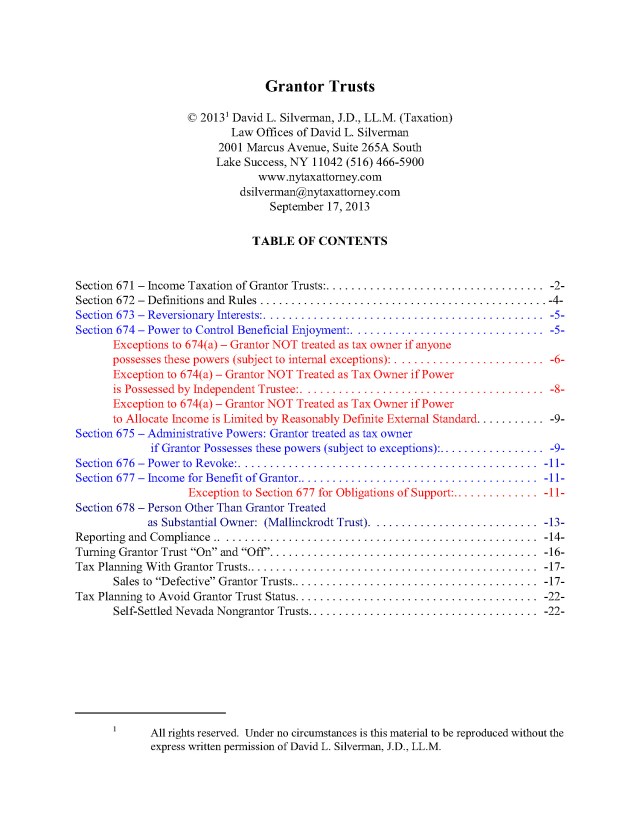
Taxation of Grantor Trusts

Grantor Trusts

Grantor Trusts

Posted in Delaware Asset Protection Trusts, Grantor Trust Treatise, Grantor Trusts, Grantor Trusts, News, Treatises, Trusts | Tagged , , , , , , , , , , , , , , , , , , , , , , , , , , , | Leave a comment

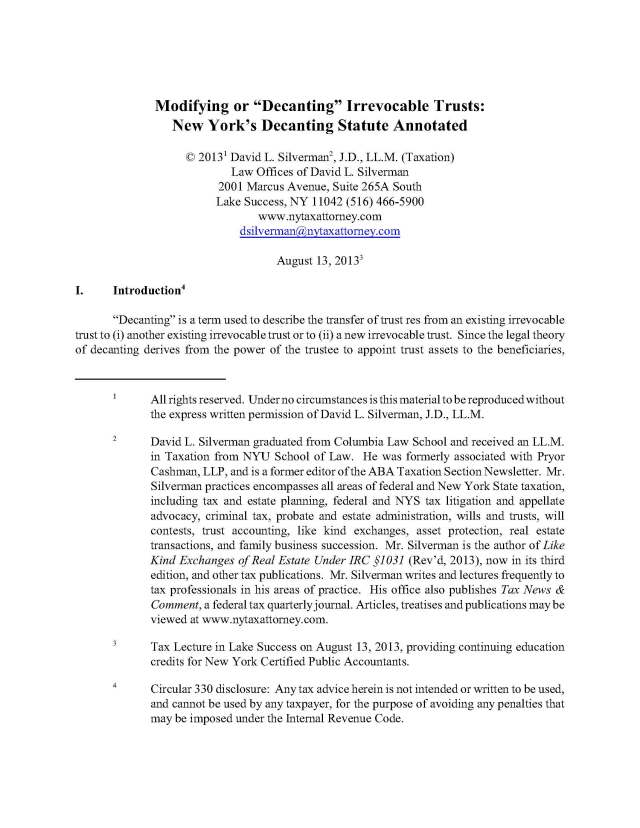
Modifying or “Decanting” Irrevocable Trusts: New York’s Decanting Statute Annotated

Modifying or "Decanting" Irrevocable Trusts: New York's Decanting Statute Annotated

Posted in Decanting, Decanting, News, Treatises, Trusts | Tagged , , , , , , , , , | Comments Off on Modifying or “Decanting” Irrevocable Trusts: New York’s Decanting Statute Annotated

Income Taxation of New York Trusts

Income Taxation of New York Truss

Income Taxation of New York Truss

Posted in Asset Protection Trusts, Estate Planning, Income Taxation of New York Trusts, New York State Income Tax, Treatises, Trustees, Trusts | Tagged , , , , , , , , , , | Leave a comment

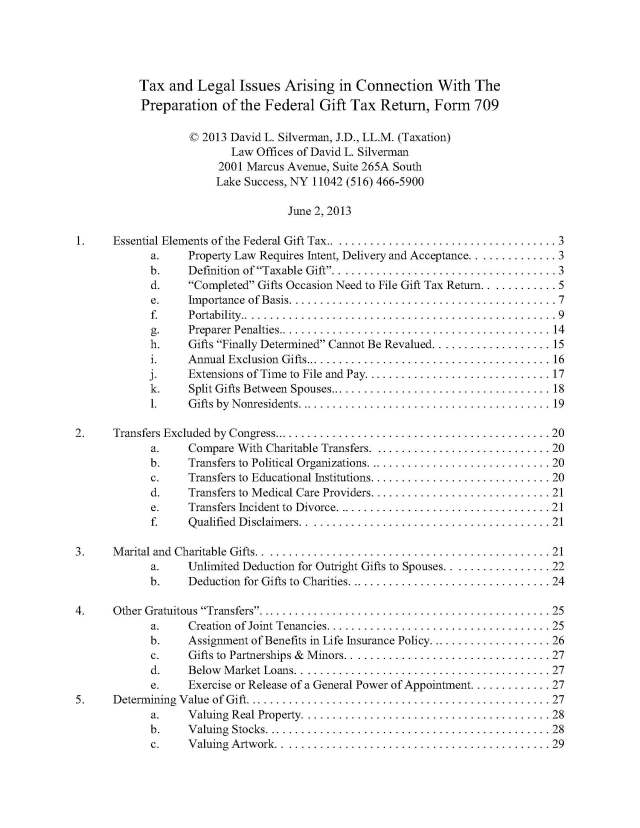
Tax and Legal Issues Arising in Connection With The Federal Gift Tax Return (2013 Revision)

Tax and Legal Issues Arising in Connection With The Preparation of the Federal Gift Tax Return

Tax and Legal Issues Arising in Connection With The Preparation of the Federal Gift Tax Return

Posted in Estate Planning, Federal Gift Tax, Gift Tax Planning, Gifts to Minors, Tax & Legal Issues Arising in Connection with the Federal Gift Tax Return (2013 Revision), Treatises | Tagged , , , , , , , , , , | Leave a comment

The Decedent’s Last Will: A Final Profound Statement

The Decedent's Last Will: A Final Profound Statement

The Decedent’s Last Will: A Final Profound Statement

Introduction.    A will is a written declaration providing for the transfer of property at death. Although having legal significance during life, the will is without legal force until it “speaks” at death. Upon the death of the decedent, rights of named beneficiaries vest, and some obligations of named fiduciaries arise. However, the will cannot operate to dispose of estate assets until it has been formally admitted to probate. Historically a “will” referred to the disposition of real property, while a “testament” to referred to a disposition of personal property. Today, that distinction has vanished.

The will operates on the estate of the decedent, determining the disposition of all probate assets. However, its sphere of influence does not end there: Under NY Estates, Powers and Trusts law (EPTL), the will can dictate how estate tax is imposed on persons receiving both probate and nonprobate assets. Probate assets are those assets capable of being disposed of by will. Not all assets are capable of being disposed of by will. For example, a devise of the Adirondack Northway to one’s heirs — although a nice gesture — would be ineffective. Similarly, one cannot dispose by will of assets held in joint tenancy, such as a jointly held bank account or real property held in joint tenancy, since those assets pass by operation of law, regardless of what a contrary (or even identical) will provision might direct.

So too, a life insurance policy which designates beneficiaries other than the estate on the face of the policy would trump a conflicting will designation. However, litigation could ensue, especially if the conflicting will provision appeared in a will executed after the beneficiary designation was made in the insurance policy. The reason for the insurance policy prevailing over the will designation is not altogether different from the situation involving the Northway: The insurance company will have been under a contractual obligation to pay the beneficiaries. That obligation arguably cannot be affected by a conflicting will provision since this would cause the insurance company to breach its obligations to the named beneficiaries under the life insurance contract, just as the transfer by Albany to the decedent’s beneficiaries of title to the Northway would breach the obligation of New York to retain title over the public thoroughfare.

Note that the decedent could properly dispose of the insurance policy by will if the life insurance policy instead named the estate of the decedent as the sole beneficiary. In fact, in that case, only the will could dispose of the insurance contract. If there were no will, the contract proceeds would pass by intestacy to the decedent’s heirs at law. If the testator has a good idea to whom he wishes the proceeds of the policy to pass following his death, it is generally a poor idea to own the policy outright, regardless of whether the proceeds of the policy are paid to the estate of the decedent or to beneficiaries named in the policy. This is so because if the decedent owns the policy, the asset will be included in his gross estate, and therefore will be subject to federal and New York estate tax. This result also illustrates the concept that the gross estate for federal and NYS estate tax purposes includes both probate and nonprobate property.

By virtue of transferring the policy into an irrevocable life insurance trust, the testator could avoid this potential estate tax problem. If the testator is planning to purchase a new policy, the trustee of a new or existing trust should purchase the policy. If the testator wishes to transfer an existing policy to a trust, the Internal Revenue Code (which New York Tax Law follows) provides that he must live for three years following the transfer for the policy to be excluded from his gross estate. If the decedent is not sure to whom he wishes to leave the insurance policy, creating an irrevocable life insurance trust to own the policy may not be a good idea, since the beneficiary designation will be irrevocable. However, if the testator knows to whom he wishes the policy benefits to pass, an irrevocable trust may reduce estate tax. The insurance policy will also have greater asset protection value if placed in trust. Finally, the proceeds of the life insurance policy held in trust could be used by beneficiaries to pay estate taxes. This can be helpful if the estate is illiquid.

II.    Formalities of Execution

A will may be executed by any person over the age of majority and of sound mind. The Statute of Frauds (1677) first addressed the formalities of will execution. Until then, the writing of another person, even in simple notes, constituted a valid will if published (orally acknowledged) by the testator. The statute required all devises (bequests of real property) to be in writing, to be signed by the testator or by some person for him in his presence and by his direction, and to be subscribed to by at least three credible witnesses. The rules governing the execution of wills in New York and most other states (except Louisiana, which has adopted the civil law) have remained fairly uniform over the centuries. The common law rules of England have since been codified in the States. In New York, these statutory rules are found in the EPTL (“Estates, Powers and Trust Law”).

For a will to be valid, the EPTL provides that the testator must (i) “publish” the will by declaring it to be so and at the same time be aware of the significance of the event; (ii) demonstrate that he is of sound mind, knows the nature of his estate and the natural objects of his bounty; (iii) dispose of his property to named beneficiaries freely and willingly; and (iv) sign and date the will at the end in the presence of two disinterested witnesses. While the execution of a will need not be presided over by an attorney, the EPTL provides that where an attorney does preside over execution, there is a presumption that will formalities have been observed. The execution of a “self proving” affidavit by the attesting witnesses dispenses with the need of contacting those witnesses when the will is later sought to be admitted to probate.

A will should be witnessed by two disinterested persons. A will witnessed by two persons, one of whom is interested, will be admissible into probate. However, the interested witness will receive the lesser of the amount provided in the will or the intestate amount. A corollary of this rule is that anyone who receives less under the will than under intestacy would suffer a detriment by being the only other witness. In general, it is not a good idea for an interested person to witness a will, although there are of course times when this admonition cannot be heeded. The rule is less harsh if the execution of the will is witnessed by two disinterested witnesses in addition to the interested witness. In this case, the interested witness is permitted to take whatever is bequeathed to him under the will, even if this amount is more than he would have received by intestacy.

III.     Rights of Heirs

Following the testator’s death, the original will may be “propounded” to the Surrogate’s Court for probate. For a propounded will to be admitted, the Surrogate must determine whether the will was executed in accordance with the formalities prescribed in the EPTL. If the decedent dies intestate (without a will) the estate will still need to be administered in order to dispose of the estate to “distributees.” The term distributee is a term of art which defines those persons who take under the laws of descent in New York. A beneficiary under the will may or may not be a distributee, and vice versa. All distributees, whether or not provided for in the will, have the right to appear before the Surrogate and challenge the admission of the will into probate. Thus, even distant heirs may have a voice in whether the will should be admitted to probate. Distributees may waive their right to appear before the Surrogate by executing a waiver of citation. A distributee waiving citation is in effect consenting to probate of the will. Distributees, either when asked to sign the waiver, or when being served with a Citation, will be provided with a true copy of the will.

If a distributee does not execute a waiver, he must be served with a citation to appear before the Surrogate where he may challenge the admission of the will into probate. Since a distributee having a close relation to the decedent would be the natural objects of the decedent’s bounty, the disinheritance of a closely related distributee would have a higher probability of being challenged than would the disinheritance of a distant heir.
Persons taking under the will who are not distributees are also required to be made aware that admission of the will into probate is being sought. Those persons would receive a Notice of Probate, but would have no statutory right to receive a citation. A Notice of Probate is not required to be sent to a distributee. Any person in physical possession of the will may propound it for probate. Not propounding the will with respect to which one is in physical possession works to defeat the decedent’s testamentary intent. Accordingly, legal proceedings could be brought by distributees (those who would take under the laws of intestacy) or other interested persons to force one in possession of the will to produce a copy of the will and to propound the will for probate. It appears that an attorney in possession of the original will is under an ethical, if not a legal, duty to propound the will into probate. The NYS Bar Ethics Committee observed that an attorney who retains an original will and learns of the client’s death has an ethical obligation to carry out his client’s wishes, and quite possibly a legal obligation…to notify the executor or the beneficiaries under the will or any other person that may propound the will…that the lawyer has it in his possession. N.Y. State 521 (1980).

IV.   Importance of Domicile

A will of a decedent living in New York may only be probated in the county in which the decedent was “domiciled” at the date of death. The traditional test of domicile is well established. “Domicile is the place where one has a permanent establishment and true home.” J. Story, Commentaries on the Conflict of Laws § 41 (8th ed. 1883). Therefore, the will of a decedent who was a patient at NYU Medical Center for a few weeks before death but was living in Queens before his last illness would be probated in Queens County Surrogate’s Court. The issue of domicile has other important ramifications. For example, while New York imposes an estate tax, Florida does not. In addition, “ancillary” probate may be required to dispose of real property held by a New York domiciliary in another state. For this reason, it is sometimes preferable to create a revocable inter vivos trust to hold real property that would otherwise require probate in another jurisdiction. Converting real property to personal property by deeding it into a limited liability company might also provide a solution, since personal property (in contrast to real property) may be disposed of by will in the jurisdiction in which the will is probated.

V.    Admission to Probate

If no objections are filed, and unless the instrument is legally defective, the original instrument will be “admitted” to probate. In practice, clerks in the probate department make important decisions affecting the admission of the will into probate. For this reason, among a legion of others, probating of wills of decedents by persons other than attorneys is ill-advised. Following the admission of the will into probate, the Surrogate will issue ““Letters Testamentary” to the named Executor to marshal and dispose of assets passing under the will. If the will contains a testamentary trust, “Letters of Trusteeship” will be issued to named Trustees under the will. Letters Testamentary and Letters of Trusteeship are letters bearing the seal of the Surrogate which grant the fiduciary the power to engage in transactions involving estate assets.

VI.     Executors and Trustees

The Executor and Trustee are fiduciaries named in the will whose duty it is to faithfully administer the will or testamentary trust. The fiduciary is held to a high degree of trust and confidence. In fact, a fiduciary may be surcharged by the Surrogate if the fiduciary fails to properly fulfill his duties. In most cases, there will be only one Executor, but occasionally a co-Executor may be named. The will may also contain a designation of a successor Executor and the procedure by which a successor Executor may be chosen if none is named. A mechanism by which an acting Executor may be replaced if unable to continue serving, or may depart, if he so wishes, would also likely be addressed in the appropriate will clause. Even in cases of intestacy, a bank, for example, will require proof of authority to engage in transactions involving the decedent’s accounts. The Surrogate will issue “Letters of Administration” to the Administrator of the estate of a decedent who dies intestate. An Administrator is a fiduciary of the estate, as is the Executor or Trustee.

A trustee designation will be made for trusts created in the will. In some cases, the Executor may also be named a Trustee of a testamentary trust, but the roles these fiduciaries play are quite different, and there may be compelling reasons for not naming the Executor as Trustee. For example, the Executor may be older, and the beneficiaries may be quite young. Here, it may be desirable to name a younger Trustee. The decedent might even wish that the Trustee be the parent. Multiple trustees may also be named. A corporate or professional Trustee may be named to assist in managing Trust assets. One should be aware that trusts and trustees often form symbiotic relationships, and the costs of naming a corporate or professional Trustee should be carefully evaluated. Like the executor, a trustee is also a fiduciary. One important rule to remember when naming a trustee is that under the EPTL, a trustee may not participate in discretionary decisions regarding distributions to himself. Thus, if a sole trustee were also the beneficiary of a testamentary trust, another trustee would have to be appointed to decide the extent of discretionary distributions to be made to him.

The rule is actually a constructive one, in that it prevents deleterious estate tax consequences. The rule is also helpful from an asset protection standpoint, since a beneficiary who is also trustee could be required to make distributions to satisfy the claims of creditors. If the trust is a discretionary trust in which the beneficiary has no power to compel distributions, the trustee could withhold discretionary distributions under the creditor threat disappeared.

VII.      Avoidance of Intestacy

Unless all or most assets of the decedent have been designed to pass by operation of law, intestacy is generally to be avoided, for several reasons: First, the decedent’s wishes as to who will receive his estate is unlikely to coincide with the disposition provided for in the laws of descent. Second, the will often dispenses with the necessity of the Executor providing bond. The bond required by the Surrogate may constitute an economic hardship to the estate if the estate is illiquid. If there is no will, there will be no mechanism by which the decedent may dispense with the requirement of furnishing bond. Third, a surviving spouse has a right to inherit one-third of the decedent’s estate. If the will leaves her less, she may  “elect” against it and take one-third of the “net estate.”” However, if the decedent dies intestate, the surviving spouse has greater rights: Under the laws of descent in New York, a spouse has a right to one-half of the estate, plus $50,000, assuming children survive. If there are no children, the surviving spouse is entitled to the entire estate.

In the event no administrator emerges from among the decedent’s heirs at law, a public administrator will have to be appointed. Disputes among heirs at law may arise as to who should serve as Administrator. If there are six heirs at law with equal rights to serve as Administrator, it is possible that the Surrogate would be required to issue Letters of Administration to six different people. What a will may provide is limited only by the imagination of the testator and the skill of the attorney. This is also why it is imperative to have a will in place even where the rules of descent (intestacy) are generally consistent with the decedent’s testamentary scheme.

VIII.      Lost, Destroyed & Revoked Wills

When executing a will, the testator is asked to initial each page. Paragraphs naturally ending on one page are sometimes intentionally carried over to another page to thwart tampering by improper insertion of a substitute page. If the original will has been lost, a procedure exists for the admission of a photocopy, but the procedure is difficult and its outcome uncertain. Removing staples from the will to copy or scan it is a poor idea. To a degree not required of most other legal instruments, the bona fides of a will is dependent upon a finding that its physical integrity is unimpeachable, meaning that the will is intact and undamaged. A will that has been damaged (e.g., staples removed for photocopying) may be admissible, though not without considerable difficulty. While the Nassau County Surrogate has accepted wills whose staples have been removed without undue difficulty, some New York Surrogates take a dim view of wills that are not intact. If the original will cannot be located and was last in the possession of the decedent, there is a presumption that the will was revoked. The reasoning here is that in such cases it is likely that the decedent intentionally destroyed the will, thereby revoking it.

Revocation will also occur if the will has been mutilated. In some jurisdictions, if provisions of the will have been crossed out, the will be deemed to have been revoked. In other jurisdictions, crossing out provisions will not invalidate the will, but will result in the instrument being construed without the deleted provisions. A will may be revised in two ways:  First, a codicil may be executed. A codicil is a supplement to a will that adds to, restricts, enlarges or changes a previous will. The Execution of a codicil requires adherence to will formalities. The second and more effective means of revising a will is to execute a new one. The first paragraph of a will typically provides that all previous wills are revoked.

IX.      Whether to Destroy or Retain The Old Will

Whether to retain an old will is the subject of some disagreement. This disagreement likely arose because there are situations where the will should be destroyed, and situations where it should not be destroyed. Since a new will expressly revokes the previous will, the natural inclination might be to “tear up” an old will after executing a new one. However, this is not always the preferred course of action. The new will may be lost, secreted, successfully challenged, or for whatever reason not admitted to probate. In this circumstance, the existence of the old will may be of great moment. If the new will is not admitted to probate, an old will may be propounded for probate. If there had been a previous will, but it was destroyed, the decedent will have died intestate. In that case, the laws of descent will govern the disposition of the decedent’s estate. The retention of the old will is insurance against the decedent dying intestate. In intestacy, the laws of descent govern the disposition of the estate.

There are situations where the decedent would prefer the laws of descent to govern. In that case, it would make perfect sense for the decedent to destroy the old will. However, in many if not most situations, the decedent would prefer the terms of the old will to the laws of descent. In these cases, the old will should not be destroyed. To illustrate a situation where the old will should not be destroyed: If a will contestant demonstrates that the decedent was unduly influenced when executing the new will, an older will with similar terms could be propounded for probate. If the decedent had disinherited or restricted the inheritance of the will contestant in the previous will as well, the existence of the old will is invaluable, since a disgruntled heir, friend, or lover would be less likely to mount a will contest. Even if a will contest were to occur, and the will contestant were successful, the victory would be pyrrhic, since the contestant would fare no better under the previous will. Knowledge of the existence and terms of the previous will would also reduce the settlement value.

In some situations the old will should be destroyed: If the new will dramatically changes the earlier will, the testator might prefer the rules of intestacy to the provisions in the old will. Here, destroying the old would obviously preclude its admission to probate; the laws of intestacy would govern. To illustrate, assume wife’s previous will left her entire estate to her second husband from whom she recently separated. Under pressure from her children from a previous marriage, wife changes her will and leaves her entire estate to those children. If wife dies, a will contest would be possible. Admission of the old will (leaving everything to her husband) into probate would be the last thing that wife would want. Since intestacy (where her husband takes half the estate) would be preferable to the old will, it would be prudent for wife to destroy the old will (and any copies). Equitable doctrines may come into play where the revocation of a previous will would work injustice. Under the doctrine of “dependent relative revocation,” the Surrogate may revive an earlier will, even if that will was destroyed, if the revised will is found to be inadmissible based upon a mistake of law. When invoked, the doctrine operates to contravene the statutory rules with respect to the execution and revocation of wills. If the doctrine is applicable, there is a rebuttable presumption that the testator would have preferred the former will to no will at all.

X.     Objections to Probate

Objections to probate, if filed, may delay or prevent the will from being admitted to probate. If successful, a will contest could radically change the testamentary scheme of the decedent. To deter will contests, most wills contain an in terrorem clause, which operates to render void the bequest to anyone who contests the bequest. The effect of the in terrorem clause is that the failed bequest is disposed of as if the person making the challenge had predeceased the decedent. Were in terrorem clauses effective, will contests would not exist. Yet they do. Therefore, the bark of such clauses appears to be worse than their bite. Still, there is no more reason not to include an in terrorem clause in a will than there would be for omitting other boilerplate language. The existence of the clause is not likely to upset most beneficiaries’ expectations, and it could cause a disgruntled heir to pause before commencing a will contest. Although some believe that leaving a small amount to persons whom the testator wishes to disinherit accomplishes some valid purpose, doing this actually accomplishes very little. A small bequest to a distributee will neither confer upon nor detract from rights available to the distributee, and consequently would have little bearing on the ultimate success of a will contest. Some testators prefer to use language such as “I intentionally leave no bequest to John Doe, not out of lack or love or affection, but because John Doe is otherwise provided for” or perhaps language stating that the lack of a bequest is “for reasons that are well understood by John Doe.”

XI.      Liability and Apportionment of Estate Tax

Who will bear the responsibility, if any, for estate tax is an important — but frequently overlooked — issue when drafting a will. The default rule in the EPTL is that all beneficiaries of the estate pay a proportionate share of estate tax. One exception to the default allocation scheme is that estate tax would rarely be apportioned to property passing to the surviving spouse and which qualifies for the full marital deduction. The technical reason for not apportioning estate tax to a bequest that qualifies for the marital deduction is that it leads to a reduced marital deduction, and a circular calculation, with an attendant increase in estate tax. To qualify for the marital deduction, a bequest to the surviving spouse must pass outright or in a qualified trust. If estate tax is paid from the bequest, then the amount passing outright (or in trust) is diminished. This results in a circular calculation. The same rationale applies to other bequests that qualify for an estate tax deduction, such as a charitable bequest to an IRC Section 501(c)(3) organization. If a large residuary bequest were made to a charity, the testator might want the charity to bear the entire liability for estate tax, even though such a direction in the will would result in a net increase in estate tax liability.

Note that property not included in the decedent’s gross estate is never charged with estate tax, even if the disposition occurs by reason of the decedent’s death (e.g., proceeds of an irrevocable life insurance trust paid to a beneficiary of the trust). This is because under IRC Section 2033, estate tax is imposed on “the value of all property to the extent of the interest therein of the decedent at the time of his death.” Assets not owned by the decedent at the time of his death are not ““interests” within Section 2033, and therefore are not part of his gross estate for purposes of the Internal Revenue Code. The allocation of estate tax liability is therefore within the exclusive jurisdiction of the decedent’s will. The default rule found in the EPTL can be easily overridden by a provision in the tax clause of the will. This gives the drafter flexibility in apportioning estate tax. In a sense, the ability of the will to control the tax consequences of assets passing outside of the probate estate is an exception to the rule that the will governs the disposition only of probate assets. If the decedent dies intestate, the default EPTL provision will control.

In many cases, the testator will choose the default rule under the EPTL, which is to apportion estate tax among the beneficiaries according to the amounts they receive. As noted, no estate tax is apportioned to assets not part of the gross estate even if those assets pass by reason of the testator’s death. For example, the proceeds of an irrevocable life insurance trust are not included in the decedent’s gross estate, and any attempt to impose estate tax liability on the named beneficiary of the policy would fail. However, if the insurance policy were owned by the decedent at his death and passed to either a named beneficiary or was made payable to his estate, the beneficiary (or the estate) could and would be called upon to pay its proportionate share of estate tax, unless expressly absolved of that responsibility in the will. Since the testator is free to change the default rule, the tax clause could direct that estate tax be paid entirely from the residuary estate, “as a cost of administering the estate.” Alternatively, the tax clause could direct that estate tax be paid out of the probate estate, meaning that the estate tax would be apportioned to all persons taking under the will. Alternatively, the will might also be silent with respect to the estate tax, in which case the EPTL default rule would govern.

To illustrate the importance of the tax clause provision, assume the decedent’’s will contained both specific bequests and residuary bequests. Assume further that the decedent owned a $1 million life insurance policy naming his daughter as beneficiary.
If the will is silent concerning estate tax, the default rule of the EPTL would control, and every beneficiary, whether taking under the will by specific or residuary bequests, or outside  of the will (i.e., insurance policy payable by its terms to a named beneficiary), would pay a proportionate share of estate tax. If the tax clause instead provided that all taxes were to be paid from the residuary estate as a cost of administration, no tax would be imposed on the daughter who receives the insurance, or on persons receiving preresiduary specific bequests under the will.

XII.   Revocable Inter Vivos Trusts as  Testamentary Substitutes

Relatively speaking, probate in New York is neither expensive nor time-consuming. Nevertheless, a revocable inter vivos trust is sometimes utilized in place of a will. Avoiding probate may be desirable if most assets are held jointly or would pass by operation of law. In that case, the necessity of a will would be diminished. Other reasons for avoiding probate may stem from considerations of cost or concerns about privacy. While trusts are generally private, wills are generally public. Letters of trusteeship are not required for an inter vivos trust, since the trust will have became effective prior to the decedent’s death, and the trustee will already have been acting. Revocable inter vivos trusts have been said to reduce or estate taxes. While technically true, the assertion is somewhat misleading. While a properly drafted revocable inter vivos trust may well operate to reduce estate taxes, a properly drafted will can also accomplish that objective. Revocable inter vivos trusts do accomplish one task very well: They eliminate the need for ancillary probate involving real property situated in another state.

A revocable inter vivos trust is funded during the life of the grantor (or trustor) with intangible personal property such as brokerage accounts, tangible personal property such as artwork, real property, or anything else that would have passed under a will.  Assets titled in the name of a revocable inter vivos trust may reduce costs somewhat in certain situations. Unlike a will, a revocable inter vivos trust operates with legal force during the grantor’s life. When evaluating the potential probate costs that could be avoided using a trust, one should also consider the cost of transferring title of assets to a revocable inter vivos trust. If probate is not expected for many years, the present value of that cost may not exceed the immediate cost of transferring the testator’s entire estate into trust.

Most estate planning tax objectives for persons who are unmarried can be accomplished in a fairly straightforward manner using a revocable inter vivos trust. However, unless the bulk of assets are held in joint tenancy, or titled in some other form that avoids probate, avoidance of probate would not likely justify foregoing a will in favor of an inter vivos trust as the primary testamentary device. Between spouses, “joint” revocable inter vivos trusts have been used to avoid probate. In some community property jurisdictions, of which New York is not one, certain federal income tax advantages among spouses may be achieved by using a joint revocable inter vivos trust. This advantage arises because the IRS may permit a step-up in basis at date of death for all assets held by a joint inter vivos revocable trust in community property states. However, joint revocable inter vivos trusts between spouses have engendered a flurry of private letter revenue rulings from the IRS addressing basis issues. Some of the rulings are adverse. Consequently, use of joint revocable trusts in non-community property states should be avoided.

XIII.  Grantor & Nongrantor Trusts

Income tax consequences of a revocable inter vivos trust actually depend on whether the trust is a ““grantor” trust or a “nongrantor” trust for purposes of the Internal Revenue Code. If the revocable inter vivos trust is drafted as a grantor trust — and most revocable inter vivos trusts are — no income tax consequences will result. Two common ways of accomplishing grantor trust status are for the grantor to retain the power to substitute trust assets of equal value, or to retain the right to  borrow from the trust in a nonfiduciary capacity without the consent of an adverse party. If either of these powers and rights are contained in the trust, grantor trust status should ensue.

A grantor trust is “transparent” for federal income tax purposes, and the grantor will continue to report income on his income tax return as if the trust did not exist. This is a slight overstatement, as some tax advisors do recommend that the trust obtain a taxpayer identification number even for a grantor trust, and recommend filing an income tax return for the trust, but noting on the first page of the return that “the  trust is a grantor trust, and all income is being reported by the grantor.” On the other hand, if the revocable inter vivos trust is drafted as a “nongrantor” trust, then the trust becomes a new taxpaying entity, and must report income on its own fiduciary income tax return. A reason for choosing nongrantor trust status might be a desire to shift income to lower income tax bracket beneficiaries.

A nongrantor trust, for income tax purposes, is a trust in which the grantor has given up sufficient control of the assets funding the trust such that a complete transfer for income tax purposes has occurred. A grantor trust, for income tax purposes, is a trust in which the grantor has not given up sufficient control over the assets funding the trust such that a complete transfer for income tax purposes has not occurred. Both revocable inter vivos trusts “defective” grantor trusts used in estate planning are typically grantor trusts. In both cases the grantor has retained sufficient rights and powers such that the transfer is incomplete for federal income tax purposes.

The difference between the two lies in differing transfer tax consequences when the trust is formed. Where a  “defective” grantor trust is employed, the grantor also relinquishes the right to revoke the trust. This makes the trust irrevocable and the transfer complete for transfer (i.e., gift and estate) tax purposes. However, the transfer is still incomplete for income tax purposes. Defective grantor trusts are useful when the grantor wishes to make use of the gift tax exemption to shift appreciation out of his estate, but at the same time wishes to remain liable for the annual income tax generated by trust assets. By remaining liable for income tax, the trust assets will grow more quickly, with no annual income tax burden being imposed on the trust.

XIV.    Transferring Assets Into Revocable Inter Vivos Trust

Transferring intangible assets into an inter vivos trust is fairly straightforward: A brokerage or bank account need only be retitled into the name of the trust. So too, ownership of real property would simply require transferring the property by quitclaim deed into the trust. Transferring tangible personal property is more problematic. Care must be taken to execute formal legal documents evidencing the transfer. Only then will the Trustee be comfortable making the distributions called for in the trust to beneficiaries. For example, if valuable artwork is transferred into a revocable inter vivos trust with a flimsy one page undated document, it may be difficult to justify the transfer to the decedent’s heirs at law who may in effect be disinherited by virtue of the trust. In contradistinction, it would be difficult for a disgruntled heir to challenge a specific bequest of artwork in a will.

XV.    Irrevocability of Inter Vivos Trust At Death of Grantor

A revocable inter vivos trust may be made irrevocable prior to the death of the grantor. If the trust is a grantor trust, the trust will resemble a “defective” grantor trust discussed above. If the trust is a nongrantor trust, then the transfer will be complete for income, gift and estate tax purposes. A revocable inter vivos trust becomes irrevocable at the death of the grantor, since the grantor, having died, can no longer revoke it. Since Letters of Trusteeship are not required, the Surrogate will not even be aware of the trust. In contrast, the Trustee of a testamentary trust will be required to request Letters of Trusteeship from the Surrogate. In general, unless a transfer is complete for transfer tax purposes, creditor protection will not arise. Therefore, revocable inter vivos trusts have virtually no asset protection value. Since the transfer may be revoked, no transfer for federal transfer tax purposes will have occurred when assets are retitled into the name of a revocable inter vivos trust. A creditor will be able to force the grantor of a revocable inter vivos trust to revoke the trust, thereby rescinding the transfer and laying bare the assets for the disposal of the creditor. It is conceivable that a revocable inter vivos trust drafted as a nongrantor trust would have slight creditor protection, but this would probably be a theoretical point with little practical significance.

XVI.  The “Pour Over” Will

What would bring to the attention of Surrogate’s Court the existence of the trust would be the decedent’s “pour over” will, if it were probated. The purpose of a pour over will is to collect and dispose of assets not passing by operation of law at the decedent’s death, and which were not transferred into the trust earlier. If no probate assets exist at the decedent’s death, there would be no reason to probate the pour over will. Where probate of the pour over will is required, the expense of probate, although not entirely avoided, would be reduced.

XVII.   Testamentary Trusts

The coverage of wills in the EPTL is extensive, while that of revocable inter vivos trusts is relatively sparse. Although trust law is well developed, it is less developed for revocable inter vivos trusts. Probate lends an aura of authoritativeness and finality to the administration of an estate that is simply not possible where a revocable inter vivos trust is used. In many cases, tax planning is actually more straightforward where a will is utilized rather than an inter vivos trust. For these reasons, most attorneys reserve the use of revocable inter vivos trusts to unique situations where they are peculiarly advantageous as testamentary vehicles. Both credit shelter and marital trusts may be funded at the death of the grantor of a revocable inter vivos trust which becomes irrevocable at death. As noted, revocable inter vivos trusts to a limited extent operate as will substitutes. However, another type of trust may present itself in the will. Many wills contain testamentary trusts. Testamentary trusts are often the foundation of the decedent’s will. Skillful drafting further important estate tax objectives. Testamentary trusts also serve to insulate the assets from potential creditors of the beneficiaries, or may protect the beneficiaries from their own immaturity or profligacy.

Testamentary trusts funded by the will may take the form of a marital trust for the benefit of a spouse, or a credit shelter trust for the benefit of children, grandchildren. The surviving spouse may also be a beneficiary (but not the sole beneficiary) of the credit shelter trust. Testamentary trusts often combine the benefit of holding property in trust with attractive tax features. Note that a revocable inter vivos trust becomes revocable at the death of the grantor. However, the trust is not a testamentary trust because it does not arise at the death of the decedent. It has already been in existence. Nevertheless, testamentary trusts and revocable trusts that become irrevocable at the date of the decedent’s death may operate in tandem, and may, if the terms of the trusts permit, become unified after the decedent’s death.

XVIII.     Estate Taxes

Neither property funding a marital trust nor property funding a credit shelter trust will result in estate tax in the first spouse to die. The mechanism for arriving at the incidence of no tax differs: In the case o a marital bequest, the amount is includable in the decedent’s gross estate, but a complete marital deduction will cancel the estate tax. In the case of a bequest utilizing the applicable exclusion amount, no estate tax will arise because Congress or Albany issues a credit nullifying the estate tax liability. As in most areas of the tax law, a credit is preferable to a deduction. In the case of the marital deduction, the property will eventually be included in the estate of the surviving spouse, unless it is consumed by the surviving spouse during that spouses lifetime, or gifted. If consumed, no tax will arise. If gifted, the gift will be subject to federal gift tax.

The largesse of Washington is greater than that of Albany with respect to the applicable exclusion amount: While Washington currently allows $5 million to pass tax-free to beneficiaries other than the spouse, Albany allows only $1 million to pass tax-free at death. Note that there would be no reason to waste the credit for bequests in which only the spouse benefits, since marital bequests can be drafted to qualify for the marital deduction.  Both Washington and Albany allow a full marital deduction for lifetime and testamentary gifts to a spouse. There is one catch to the generosity of Washington: The Internal Revenue Code includes in the $5 million applicable exclusion amount lifetime gifts. So a lifetime gift of $1 million would reduce to $4 million the amount that can pass at death without the imposition of estate tax. Furthermore, the gift tax exemption amount may be reduced after 2012. In a rush to complete the tax bill in late 2010, Congress unexpectedly increased the lifetime gift tax exemption from $1 million to $5 million. If President Obama is reelected, there is no assurance that his administration will not seek to reduce the lifetime gift tax exclusion amount.

There is another fundamental difference between the philosophy of New York and Washington concerning transfer taxes: While the IRS taxes lifetime gifts, New York does not. Therefore, making lifetime gifts before 2012 to avoid the inclusion of assets in the estate for New York estate tax purposes makes sense for testators with large estates. Making such gifts now will be neutral for federal purposes (since the applicable exclusion amount applies equally to lifetime and testamentary transfers) but will reduce New York State estate tax by 16 percent of the amount of the gift. (Sixteen percent is the maximum rate of estate tax now imposed by New York.)

XIX.     QTIP Trusts & Credit Shelter Trusts

In general, to qualify for a complete marital deduction, property must pass outright or in a qualifying trust to the surviving spouse. A “QTIP” marital trust is such a qualifying trust. The QTIP grants the surviving spouse a lifetime income interest, and perhaps a discretionary right to trust principal. The decedent retains the right to designate ultimate trust beneficiaries, but no beneficiary other than the surviving spouse can have any interest in QTIP trust assets during the life of the surviving spouse. QTIP trusts are sometimes used in second-marriage situations, or in situations where the testator is concerned that the surviving spouse might deplete trust assets leaving few assets for his children. The surviving spouse with an interest in a QTIP trust has the right to demand that the trustee make nonproductive assets productive.

For estate tax purposes, the IRS requires that the estate of the surviving spouse include the fair market value of the assets in the QTIP trust at her death. For income tax purposes, two basis step ups occur: The first at the death of the decedent, and the next basis step up at the death of the surviving spouse. Even though the property in a QTIP trust does not “pass” to the surviving spouse outright, Congress justified marital deduction on the basis of the surviving spouse having a lifetime income interest in the trust, and no other beneficiary having an interest during the life of the surviving spouse. The deduction provided by the Internal Revenue Code for assets funding a QTIP trust is actually an exception to the “terminable interest” rule. That rule provides that no marital deduction can be allowed for a bequest to a surviving spouse of an interest that “terminates.”

The surviving spouse can be given the right to receive discretionary distributions of principal from a QTIP trust for her “health, comfort and maintenance” without triggering adverse estate tax consequences. The surviving spouse may also be given a “five and five” power, which gives the surviving spouse the noncumulative right to demand on an annual basis from the trust an amount which is the greater of (i) five percent of the value of the trust or (ii) five thousand dollars. Giving the spouse more rights than these in a QTIP trust could result in the IRS arguing that the trust no longer qualifies as a QTIP trust. Since the decedent would have retained the right to name ultimate trust beneficiaries, the trust would also not qualify for the unlimited marital deduction as a general power of appointment trust. (If the trust were a general power of appointment trust, the surviving spouse would have the right to appoint trust assets, which she does not in a QTIP trust). Thus, the marital deduction could be imperiled.

A credit shelter trust takes the asset out of both the estates of the testator and the spouse permanently. A surviving spouse may or may not be given an interest in a credit shelter trust. Again, the surviving spouse should not be given too great an interest in the credit shelter trust; otherwise, the IRS could argue that the assets are includible in her estate. Still, it appears entirely reasonable to give the spouse a right to income and a discretionary right to principal for her health, comfort and maintenance. Health, comfort and maintenance are ascertainable quantities generally considered to be within the discretion of the trustee. Accordingly, most courts would not challenge the trustee’s discretion. However, the IRS would be less reluctant to question the scope of the trustee’s discretion if the IRS believed that the trustee had exceeded the scope of his discretion. The credit shelter trust would provide for other beneficiaries. If the intended beneficiaries of a credit shelter trust were older, then the testator would likely have creditor protection objectives in mind when deciding to leave assets to his mature children in trust rather than outright.
Funding the credit shelter trust within the will involves determining how many assets the surviving spouse may need. Until a few years ago, when the applicable exclusion amount was less than $5 million, it was sometimes desirable to fund the credit shelter trust with the maximum amount, thereby removing the assets from the estate of both spouses.

With the federal applicable exclusion amount at $5 million, maximizing the amount funding the credit shelter trust may operate to reduce or eliminate an alternate bequest to the surviving spouse. On the other hand, if the credit shelter trust is underfunded and the marital trust overfunded, the estate of the surviving spouse might needlessly become subject to New York estate tax. In the majority of cases tax considerations are secondary — as they should be — to the desire of the decedent to provide for his or her spouse. Use of a disclaimer provides post-mortem flexibility, in that it allows the surviving spouse to renunciate assets not required, with extremely favorable transfer tax consequences.

XX.   Disclaimers

In general, if a person executes a written disclaimer within nine months of the decedent’s death, and has not accepted any of the benefits of the disclaimed assets, then the property will pass as if the disclaimant had predeceased. A significant transfer tax benefit may result from a properly executed a disclaimer. If a person accepts a bequest, and then decides to transfer the bequest, a taxable gift will have been made. In contrast, if the person disclaims the bequest, no taxable gift has occurred, since the person never received the property.
Although a disclaimant may not direct property to a specific person, the will may be drafted to contain specific language providing that a disclaimer made by a surviving spouse could fund a credit shelter or other trust in which she is a beneficiary. The language might provide that the surviving spouse’s disclaimer would add to or fund a credit shelter trust in which she is a lifetime beneficiary. If the surviving spouse is given an income interest in a trust into which she disclaims, this may increase the likelihood that she will disclaim. This may reduce or eliminate estate tax at her death, yet still provide her with lifetime enjoyment of trust assets. If the surviving  spouse cannot be relied upon to disclaim what she will not need, the trustee’s discretion with respect to distributions of principal from a credit shelter (or other) trust may serve to adequately protect the interest of other beneficiaries, such as the children.

The reasons for a disclaimer are legion, and they are by no means limited to situations involving taxes. A disclaimer may also be made to protect assets from claims of creditors. In some jurisdictions, such as New Jersey, a disclaimer that works to defeat the rights of creditors is fraudulent. However, in New York a disclaimer made to defeat the rights of a creditor is valid. However, a disclaimer cannot work to defeat the rights of the IRS if the named beneficiary under the will exercises the disclaimer to defeat the those rights. Drye v. U.S., 428 U.S. 49 (1999).

XXI.    The Right of Election & Testamentary Substitutes

A will may be used to disinherit children, but not a spouse. Divorce will not invalidate a will, but will have the effect of treating the former spouse as if she had predeceased. On the other hand, a disposition made to a former spouse following a divorce — or even a bequest made prior to a divorce but expressly stating that the bequest survives divorce —  would be valid. In New York, the surviving spouse must be left with at least one-third of the testator’’s estate. Otherwise, the surviving spouse may “elect” against the will, and take one-third of the “net estate.” If the elective share of the surviving spouse exceeds what the surviving spouse received under the will or by operation of law, the estate of the decedent will be required to pay the electing spouse that difference. If the property was already transferred to another person, the statute would appear to require that the transfer be rescinded.

If a spouse wished to circumvent the rule that he or she bequeath at least one-third of his or her estate to the surviving spouse, this could theoretically be accomplished by making gifts before death of large portions of the estate. To foreclose this opportunity to avoid the elective share rule, the legislature created the concept of “testamentary substitutes.” The net estate, which is the basis upon which the elective share operates, includes “testamentary substitutes” in addition to other assets comprising the decedent’s estate. If the decedent dies intestate, testamentary substitutes are generally those assets which the decedent transferred before death, which are no longer part of his probate or nonprobate estate.

The intent of the legislature in creating the concept of testamentary substitutes was to protect the surviving spouse from the intentional depletion of the decedent’s estate by means of lifetime transfers occurring before the spouse’’s death. Although the definition of testamentary substitutes operates primarily on transfers made in the year before the decedent’s death, some transfers qualifying as testamentary substitutes may have been made years earlier. Life insurance is not a testamentary substitute. Thus, the purchase of a life insurance policy within a year of death will not be part of the net estate for calculating the elective share, even if the beneficiary is other than the surviving spouse. It is believed that the reason life insurance is not within the statutory class of testamentary substitutes is not based upon any legally distinguishable characteristic of life insurance, but rather on the reality that were it so classified, the life insurance industry would be adversely affected.

The concept of testamentary substitutes, although primarily operating to prevent depletion of the net estate for elective share purposes, is not limited to protecting rights of the surviving spouse: The statute provides that testamentary substitutes include transfers “whether benefiting the surviving spouse or any other person.” Thus, if an elective claim were made by a surviving spouse, a child could argue that a transfer made years earlier by the decedent to the surviving spouse was actually a testamentary substitute. The child’s argument, if successful, would augment the net estate with respect to which the surviving spouse would be entitled to one-third.

However, since the surviving spouse would already hold title to the property constituting a testamentary substitute, this would “count” toward her elective share. Thus, for elective share purposes, the surviving spouse would be entitled only to one third of an asset already owned by her. This could result in the elective share being less than what the spouse otherwise received under the will or by operation of law. In that case, the spouse would simply forego the elective share. In general, the categorization of a transfer as a testamentary substitute works to the disadvantage of the electing spouse if she already owns a significant number of assets that may be susceptible to being classified as a testamentary substitute. This is because the entire value of the asset will “count” toward meeting her one-third elective share.

To illustrate, if a spouse transfers title to the marital residence but retains the right to enjoy or possess the property during his life, the transfer may be deemed to constitute a testamentary substitute. The inclusion of the residence would increase the size of the net estate with respect to which the surviving spouse would be entitled to a third. Being in title to the residence, its entire value would count toward satisfying the requirement that the surviving spouse receive one-third of the net estate. A spouse may waive the statutory right under EPTL 5-1.1A to elect against the will of the other spouse or, may under EPTL 4-1.1, may waive the right to one-half of the spouse’s estate in the event of intestacy.

XXII.    Residuary & Preresiduary Bequests

There are two classes of bequests: preresiduary bequests and residuary bequests. Preresiduary bequests, which generally consist of specific bequests, are sometimes easier to administer than residuary bequests.  Specific bequests of tangible personal property are almost always pre-residuary bequests. Specific bequests might also be made of intangible personal property, such as money or bank accounts. However, to the extent money, bank or brokerage accounts are not disposed of by specific bequest, they will be disposed of in the residuary estate.

A “bequest” then is gift of under the decedent’s will. A “legacy” is a bequest of personal property, while a “devise” is a bequest of real property. An “inheritance”” as it is typically thought of is somewhat of a misnomer, since it refers to real or personal property received by heirs pursuant to the laws of descent (intestacy). However, a nontechnical meaning of “inheritance” refers to bequests under the will. The failure to use the correct term (e.g., referring to a bequest of land as a legacy) in a will would of course not defeat the bequest.
When administering the estate, the Executor will first determine specific bequests to be made from probate assets. Every probate asset in the decedent’s estate not disposed of by specific bequest will fall into the residuary estate, and be disposed of pursuant to the terms therein. A residuary bequest might resemble the following:

I give, bequeath and devise all the rest, residue and remainder of my estate, both real and personal, of every nature and wherever situated . . . which shall remain after the payment therefrom of my debts, funeral expenses, expenses of administering my estate and the legacies and devises as hereinafter provided, to the following persons in the following proportions:

The will should also contain a provision dealing with simultaneous deaths. The will would typically provide that if any disposition under the depends on one person surviving another, if there is insufficient evidence concerning who died first, the other person will be deemed to have predeceased. An example would be where the decedent and his spouse die simultaneously, such as in an airplane or car accident. Here, the effect of the provision would be to assume for purposes of the decedent’’s will the spouse predeceased. The will may also impose a general requirement of survivorship. Thus, the instrument may require as a condition to taking under the Will that the person survive for a period of period of time (e.g., 90 days) following the death of the decedent. The reason for inserting the requirement if the beneficiary died soon after the decedent the decedent would rather that the bequest be made to other beneficiaries under his will rather to the beneficiary under his will who died before the estate was administered.

The residuary estate is often, though not always, disposed of by making gifts of fractional, rather than pecuniary amounts, to various persons either outright or in trust. If the bequest is made in trust, the “rule against perpetuities” prevents the creation of perpetual or “cascading” trusts. Black’s Law Dictionary defines the rule against perpetuities as

[t]he common-law rule prohibiting a grant of an estate unless the interest must vest, if at all, no later than 21 years (plus a period of gestation to cover a posthumous birth) after the death of some person alive when the interest was created.

[The rule has its origin in the Duke of Norfolk’s case decided by the House of Lords in 1682. The Lords believed that tying up property for many generations was wrong. A few states, among them New Jersey, have abolished the common law rule by statute. Other states, among them New York, have codified the common law rule. Still others have taken different approaches. Delaware has eliminated the rule by statute for real property, and has extended the vesting period for personal property from 21 years to 110 years. Forward-looking Utah has not abolished the common law rule, but has extended the vesting period to 1000 years. Finally, some states have adopted the “Uniform Statutory Rule Against Perpetuities,” which limits the vesting period to 90 years.]

XXIII.    Formula Bequests

A formula bequest is a bequest utilizing a formula specified in the will to determine the amount of the bequest. The formula might provide that the credit shelter trust be funded with the maximum amount that can pass free of federal estate tax, or the maximum amount that can pass free of federal or state estate tax. Formula bequests to a credit shelter or marital trust could be structure as either preresiduary or a residuary bequests.
Today, funding a credit shelter trust with the maximum amount that can pass free of federal estate tax would result in $5 million being allocated to the trust; funding the trust with the maximum amount that would result in no federal or New York estate tax would result in funding the trust with only $1 million. This is because the maximum amount that can pass free of New York State estate tax is only $1 million.
Depending on the size of the decedent’s estate, foregoing $4 million in a federal credit to save $640,000 (.16 x $4,000,000) may or may not make sense. If the decedent and his spouse are elderly and their estate is very large, wasting $4 million of the federal credit at the death of the first spouse may actually result in more federal estate tax in the future. In general, if the couple wishes to reduce estate tax to zero at the first to die, the credit shelter trust will not be funded with more than $1 million. However, one loophole the width of the lower Hudson does exist: Gifting the $4 million during life and leaving the other $1 million at death will result in no federal tax, because the applicable exclusion amount equals the total of both lifetime and testamentary transfers. The $4 million gift will not be subject to New York gift tax, since New York has no gift tax. At the death of the first spouse to die, the credit shelter trust can be funded with $1 million. Essentially, the $640,000 in New York estate tax will have been avoided at no cost.
However, the testator must actually make a gift of this money during his lifetime. The reality is also that most people with estates of $5 million are generally not willing to make gifts of $5 million.
As is readily seen, small variations in language can have important funding consequences. It is for this reason that older wills should be periodically reviewed to ensure that they fund the appropriate trust with the proper amount. If the language of the will were clear, neither the Executor nor the Surrogate would have the power to redraft the will.
For example, if the will of a decedent who died in 2009 provided in a preresiduary bequest that the credit shelter trust was to be funded with the maximum amount that can pass free of federal estate tax, the Executor would clearly be required to fund the trust with $3.5 million, if the estate had sufficient assets.
However, if the decedent with the same will died in 2010, this language would be problematic, since the estates of persons dying in 2010 could elect out of the estate tax. If an election out of the estate tax were made, would the Executor be required to fund the trust denominated in the will as a credit shelter trust, since nothing would be needed to reduce federal estate tax to zero? Even if it were assumed that the Executor were required to fund the trust, what amount would he be required to transfer to the trustee? Would the amount be the amount which the Executor would have been required to fund the trust with had the estate not elected out of the estate tax?
Another equally troubling question exists: If the election out of the estate tax results in no estate tax, but increases the future income tax liability of certain beneficiaries, how is the estate required to allocate future built-in income tax gain? These questions might require the Executor to make difficult decisions and surmise what the intent of the decedent was. While it would be appropriate for a fiduciary to make these determinations, it would be preferable if the will were clear.
The problem of basis arises because as a condition to electing out of the estate tax, the Executor must “carry over” the basis of estate assets, rather than receive a step-up. This problem is mitigated somewhat by a provision allowing the Executor to step up the basis of $1.3 million for assets passing to anyone. The Executor may also step up the basis of assets worth $3 million passing to the surviving spouse.

XXIV.   Pecuniary and Specific Bequests

A pecuniary or specific bequest is said to ““lapse” if the named beneficiary predeceases. A specific bequest is said to “adeem” if the subject matter of the bequest no longer exists at the decedent’s death. Another instance in which a bequest might fail is where there has been an “advancement.” An advancement occurs where the decedent makes a testamentary bequest, but “advances” the bequest to the beneficiary before death. For a gift to constitute an advance, it must be clearly demonstrated that the decedent intended it to be so, and the presumption is against advancements.
Specific bequests of personal property or cash must be worded carefully. Assume that the testator wishes to leave $50,000 to his aunt Matilda. The bequest might be drafted in the following way:

I leave to my aunt Matilda the sum of $50,000.

If Matilda is alive at the decedent’s death, she will receive $50,000. If Matilda has predeceased, most agree that the bequest should be paid to the estate of Matilda.

Suppose instead that the bequest was phrased in the following way:

I leave to my aunt Matilta the sum of $50,000, if she survives me.

Here Matilda would receive $50,000 if, and only if, Matilda survived the decedent. If Matilda predeceased, the bequest would lapse, and Matilda’s estate would take nothing.

If the decedent had intended for Matilda’s issue to benefit in the event Matilda predeceased, then the following language might have been employed:

I leave the sum of $50,000 to Matilda, if she survives me, or if not, to her issue, per stirpes.

The term per stirpes is latin for “by the root.” Assume Matilda bore three children, one of whom predeceased her, leaving two children. In that case, Matilda’s bequest would be divided into thirds. Her two surviving children would each take a third, and her two grandchildren (from the predeceasing child) would each take one-sixth (half of her predeceasing child’s one-third share).

The will might also have provided that the bequest be made

to Matilda if she survives me, or if not, to her issue, per capita.

The term per capita is latin for “by the head.” Assume again that Matilda bore three children, one of whom predeceased her leaving two children. Here, the bequest would be divided into four, with Matilda’s two children each taking one-fourth, and Matilda’s two grandchildren each taking one-fourth. Few testators choose per capita dispositions.
The will could also generally provide for the issue of Matilda in the event Matilda predeceased, without specifying whether the bequest was per stirpes, or per capita. Such a bequest could be made in the following way:

I leave the sum of $50,000 to Matilda if she survives me, or if not, to her issue.

In this case, the issue would take by “representation.” Assume  Matilda had three children, two of whom predeceased. One predeceasing child  bore one child, and the other predeceasing child had nine children. Matilda’s surviving child would take one-third, the same amount the child would take if the bequest had been per stirpes.
However, something else happens at the generational level of the grandchildren: Each grandchild would take a one-tenth share of the two-thirds not passing to Matilda’s surviving child. Thus, the bequest could be thought of as per stirpes at the children’’s level, and per capita at the second generation level, that of the grandchildren. Notice that Matilda’s surviving child will receive the same as she would have received had her siblings not predeceased Matilda. Yet, also notice that the grandchildren are not taking “by the root,” but rather “by the head.”
Of course, it would also be perfectly appropriate if the will provided that the grandchildren would take by representation if Matilda and at least one of her children predeceased.  In that case, the will would state

I leave $50,000 to Matilda, if she survives me, or if not, by right of representation.

If the $50,000 bequest were made to Matilda out of a specified Citibank account, Matilda would receive the $50,000 if and only if (i) the Citibank account existed at Matilda’s death and (ii) the account had sufficient assets to satisfy the bequest. If the account no longer existed, the bequest would “adeem”. If the account existed but had insufficient funds, the bequest would “lapse” to the extent of the deficiency.
A bequest may also be made of intangible personal property, such as a bank or brokerage account. The same rules apply to such bequests: If the bank account is no longer in existence, then the bequest will have adeemed, since it is no longer in existence at the time of the decedent’s death.
Bequests of items of tangible personal property would be made in the following way:

I leave my antique Chinese vase to my son Albert, if he survives me, or if not, to my daughter Ellen.

Here, if Albert predeceased, then the vase would go to Ellen, if she survived. If both predeceased, the vase would go to the estate of Ellen, pursuant to the terms of her will. If her will were silent concerning the vase, it would be disposed of pursuant to her residuary estate. If Ellen died intestate, the vase would go to Ellen’s heirs at law. If Ellen died leaving no heirs, the vase would ““escheat” to New York. Escheat means that the property reverts to the state or sovereign.
Many are of the belief that if they die intestate, all of their property escheats to the state. Nothing could be more untrue. Dying without a will is disadvantageous for many reasons, however, dying intestate simply means that the estate will pass to the decedent’s heirs at law. For some testators without closely related heirs, this might be a fate worse than the property reverting to the state. Often, wealthy persons without close heirs make large charitable bequests, rather than have their estate claimed by distant heirs whom they may not even know of. Naturally, if the testator owns two Chinese vases, the vase which is the subject of the bequest should be identified with particularity to avoid problems of identification for the Executor. Typically, the Executor will be given “unreviewable discretion” with respect to these determinations, as well as most other determinations requiring the Executor’s discretion when administering the decedent’s estate.

Posted in The Decedent's Last Will: A Final Profound Statement, Wills | Tagged , , , , , , , , , , | Leave a comment

Tax and Legal Issues Arising In Connection With the Preparation of the Federal Gift Tax Return, Form 709 — Treatise

Posted in News | Leave a comment

Like Kind Exchanges of Real Estate (2013 Revised Edition)

View in PDF: Like Kind Exchanges of Real Estate Under IRC Section 1031 (2013 Revised Ed.)
January 1 Revised LKE Treatise_Page_001

Posted in Like Kind Exchanges of Real Estate Under IRC Sec. 1031 (2013 Revised Ed.), Treatises | Tagged , , , , , , | Leave a comment

Peering Through the Legal Prism: When Asset Protection Becomes Fraudulent

VIEW IN PDFTax News & Comment — August 2011

I.  Introduction

English law addressing fraudulent conveyances dates back to the early Middle Ages. The first comprehensive attempt to prohibit such transfers appeared in the Fraudulent Conveyances Act of 1571, known as the “Statute of Elizabeth.” The Act was promulgated by Elizabeth I, daughter of Henry VIII from his second marriage to the ill-fated Anne Boleyn. The statute forbade feigned, covinous and fraudulent transfers of land and personalty entered into with the intent to delay, hinder or defraud creditors and others of their just and lawful claims.

The Statute provided that such conveyances were “clearly and utterly void, frustrate and of no effect” as against “creditors and others” whose claims might be hindered by such conveyances.

Today, as in the Middle Ages, conveyances which defeat claims of existing creditors may be challenged as being fraudulent. Asset protection is the “good witch” of asset transfers, wherein one legitimately arranges one’s assets so as to render them impervious to creditor attack. Asset protection is best implemented before a creditor appears, since a transfer made with the intent to hinder, delay or defraud a creditor may be deemed a fraudulent conveyance subject to rescission. Asset protection in its most elementary form might consist of merely gifting or consuming the asset.

Gifts made outright or to an irrevocable trust provide asset protection, assuming the transfer is bona fide. In property law, a gift requires three elements: First, the donor must intend to make a gift. Second, the donor must deliver the gift to the donee. Third, the donee must accept the gift. Whether these requirements have been met is a question of local law. (Although the IRS has dispensed with the requirement of donative intent to impose gift tax, most courts have not.)

Gifts should be delivered and be evidenced by a writing. Although transfers to family members are presumed to have donative intent, creditors may argue that the donee family member is merely holding legal title in trust or as nominee for the donor. For this reason, intrafamily gifts should be evidenced by a formal writing in which the donee accepts the gift.

Delivery of personal property should be accompanied by a written instrument. Delivery of real property requires a deed, and delivery of intangible personal property should be accompanied by an assignment or other legal document. Ownership of some intangibles, such as securities, may be accomplished by registering the securities in the name of the donee.

The retention by the donor of possession of property may suggest the absence of a gift, since no gift occurs where trustee, agent or bailee retains possession of the property. Similarly, asking a family member or a friend to “hold” property to protect against the enforcement of a known judgment creditor’s claim until the threat disappears would be subject to being declared fraudulent, since the motive for the transfer will have lacked donative intent.

Operating a business in corporate form, entering into a prenuptial agreement, executing a disclaimer, or even giving effect to a spendthrift trust provision, are common examples of asset protection which present few legal or ethical issues, primarily because such transfers do not defeat rights of known creditors. However, transferring assets into a corporation solely to avoid a personal money judgment, or utilizing an offshore trust solely to avoid alimony or child support payments, would defeat the rights of legitimate creditors, and would thereby constitute fraudulent transfers.

Businesses have traditionally limited exposure to liability by forming corporations. The limited liability of corporate shareholders has existed since 1602 when the Dutch East India Company was chartered to engage in spice trade in Asia. Yet the liability protection offered by corporate form can be negated, and the corporate veil “pierced,” if the corporation is undercapitalized.

Other business entities, such as LLCs and partnerships, also offer asset protection. Claims made against these entities, like claims made against corporations, do not “migrate” to the member or partner. A judgment creditor of a partner cannot seize the debtor’s partnership interest, but is limited to obtaining a “charging order.”
A charging order is a lien against the partner’s partnership interest.

A judgment creditor holding a charging order “stands in the shoes” of the partner with respect to partnership distributions. Therefore, if the partnership makes no distributions, the judgment creditor who has seized the partner’s interest may be charged with “phantom” income. This may cause the value of the creditor’s claim to be greatly diminished.

Disclaimers may be effective in avoiding creditor claims and are generally not fraudulent transfers under New York law. In New York, one may validly disclaim property and may thereby place the asset beyond the reach of creditors. The IRS may reach disclaimed property to satisfy a federal tax lien.

Certain powers of appointment possess asset protection features.  Limited powers of appointment are beyond creditors’ claims since the power holder has no beneficial interest in the power. Presently exercisable general powers of appointment, by contrast, in New York at least, are subject to creditors claims since the power holder has the right to appoint the property to himself. EPTL § 10-7.2.

II.    Ethical Considerations

Ethical considerations reach their zenith when asset protection is being contemplated. The obligation of an attorney to zealously represent the interests of his client is unquestioned. The ABA Model Code of Professional Conduct, DR 7-101, “Representing a Client Zealously,” provides that

A lawyer shall not intentionally fail to seek lawful objectives of his client through reasonable available means permitted by law and the Disciplinary Rules.

The Second Circuit has held that “[a] lawyer is authorized to practice his profession, to advise his clients, and to interpose any defense or supposed defense without making himself liable for damages.” Newburger, Loeb & Co. v. Gross, 563 F.2d 1057, 1080 (2nd Cir. 1977), cert. denied, 434 U.S. 1035 (1978).

Nevertheless, the ABA Model Code of Professional Conduct, DR 7-102, “Representing a Client Within the Bounds of the Law,” provides that “[a] lawyer shall not . . . [c]ounsel or assist his client in conduct that the lawyer knows to be illegal or fraudulent.”

Although the Model Code does not define “fraud,” New York, a Model Code jurisdiction, has provided that the term

does not include conduct, although characterized as fraudulent by statute or administrative rule, which lacks an element of scienter, deceit, intent to mislead, or knowing failure to correct misrepresentations which can be reasonably expected to induce detrimental reliance by another.

Therefore, in New York, the prohibition against counseling a client in perpetrating a “fraud” would apparently not prohibit an attorney from assisting a client in transferring property because of the possibility that the transfer might, in hindsight, be determined to have constituted a fraudulent conveyance.

Model Rule 8.4 of the ABA Model Rules of Professional Conduct provides that it is professional misconduct for a lawyer to “engage in conduct involving dishonesty, fraud, deceit or misrepresentation.” Model Rule 4.4 provides that “a lawyer shall not use means that have no substantial purpose other than to embarrass, delay, or burden a third person.”

Conduct involving dishonesty or an attempt to deceive appears to be a readily determinable question of fact. However, conduct employing means having no substantial purpose other than to delay or burden third parties may be a more difficult factual determination.

Connecticut Informal Opinion 91-23 states that

[f]raudulent transfers delay and burden those creditors who would be inclined to try and satisfy their unpaid debts from property of the debtor. It forces them to choose either not to challenge the transfer and suffer the loss of an uncollected debt or to file an action to set aside the transfer…If there is no other substantial purpose, Rule 4.4 applies. Where there is another substantial purpose, Rule 4.4 does not apply. For example, where there is a demonstrable and lawful estate planning purpose to the transfer Rule 4.4 would not, in out view apply.

An attorney is therefore ethically and legally permitted to provide counsel in the protection of a client’s assets. Since most prohibitions on attorneys involve the attorney having acted “knowingly,” due diligence is important to avoid ethical or legal problems. The counselor should determine (i) the source of the client’s wealth; (ii) the client’s reason for seeking advice concerning asset protection; and (iii) whether the client has any current creditor issues or is merely insuring against as yet unknown future creditor risks.

The client is also under an obligation to be truthful. Accordingly, the client should affirm that (i) it has no pending or threatened claims; (ii) it is not under investigation by the government; (iii) it will remain solvent following any intended transfers; and (iv) it has not derived from unlawful activities any of the assets to be transferred.

III. Uniform Fraudulent

    Transfer & Conveyance Acts

The definition of fraudulent transfer has remained fairly constant since the Statute of Elizabeth. While the common law doctrine of res judicata has influenced domestic courts in interpreting the common law of fraudulent conveyances, most states have chosen to codify the law. The Uniform Fraudulent Transfer Act defines the term “transfer” as

every mode, direct or indirect, absolute or conditional, voluntary or involuntary, of disposing of or parting with an asset or an interest in an asset, and includes the payment of money, release, lease, and creation of a lien or other encumbrance.

The Uniform Fraudulent Conveyance Act, the successor to the Uniform Fraudulent Transfer Act, defines a creditor as “a person having any claim, whether matured or unmatured, liquidated or unliquidated, absolute, fixed or contingent.” The Act defines the term “claim” as “a right to payment, whether or not the right is reduced to judgment, liquidated, unliquidated, fixed, contingent, matured, unmatured, disputed, undisputed, legal, equitable, secured or unsecured.” (New York is among six states that have enacted the Uniform Fraudulent Transfer Act, but not the Uniform Fraudulent Conveyance Act.)

IV.     Decisional Law

Although ample statutory authority exists, courts are often called upon to apply the common law in decide whether a conveyance is fraudulent. The doctrine of staré decisis,  which recognizes the significance of legal precedent, plays a paramount role in the evolving law governing asset transfers.

The Supreme Court, in Mexicano de Desarollo, S.A. v. Alliance Bond Fund, Inc., 527 U.S. 308, held that an owner of property has an almost absolute right to dispose of that  property, provided that the disposition does not prejudice existing creditors. Federal courts are without power to grant pre-judgment attachments since (i) legal remedies must be exhausted prior to equitable remedies; and (ii) a general (pre-judgment) creditor has no “cognizable interest” that would permit the creditor to interfere with the debtor’s ownership rights.

In determining whether a transfer is fraudulent, New York courts have made a distinction between future and existing creditors. Klein v. Klein, 112 N.Y.S.2d 546 (1952) held that the act of transferring title to the spouse of a police officer to eliminate the threat of a future lawsuit against the officer arising by virtue of the nature of his office was appropriate, and “amounted to nothing more than insurance against a possible disaster.”

Similarly, in Pagano v. Pagano, 161 Misc.2d 369, 613 N.Y.S.2d 809 (N.Y. Sur. 1994), family members transferred property to another family member who was not engaged in business. The Surrogate found there was no fraudulent intent and that

transfers made prior to embarking on a business in order to keep property free of claims that may arise out of the business does not create a claim of substance by a future creditor.

The New York County Surrogates Court, in In re Joseph Heller Inter Vivos Trust, 613 N.Y.S.2d 809 (1994), approved a trustee’s application to sever an inter vivos trust for the purpose of

insulat[ing] the trust’s substantial cash and securities from potential creditor’s claims that could arise from the trust’s real property.

The Surrogate observed that

New York law recognizes the right of individuals to arrange their affairs so as to limited their liability to creditors, including the holding of assets in corporate form…making irrevocable transfers of their assets, outright or in trust, as long as such transfers are not in fraud of existing creditors.

V.   Establishing Fraudulent Intent

Intent is subjective and proving it is difficult. Direct evidence of fraudulent intent, such as an email or a tape, is not likely to exist. Courts have therefore resorted to circumstantial evidence in the form of “badges of fraud.” Whether badges of fraud exist is determined by assessing (i) the solvency of the debtor immediately following the transfer; (ii) whether the debtor was sued or threatened with suit prior to the transfer; and (iii) whether the debtor transferred property to his or her spouse, while retaining the use or enjoyment of the property.

Under NY Debt. & Cred. Law § 273-a, a conveyance made by a debtor against whom a money judgment exists is presumed to be fraudulent if the defendant fails to satisfy the judgment. Transfers in trust at one time were, but are no longer, considered a badge of fraud. However, transfers in trust may implicate a badge of fraud if the transferor retains enjoyment of the transferred property.

Once the existence of a fraudulent transfer has been established, the Uniform Fraudulent Transfer Act provides that the creditor may (i) void the transfer to the extent necessary to satisfy the claim; (ii) seek to attach the property; (iii) seek an injunction barring further transfer of the property; or, if a claim has already been reduced to judgment, (iv) levy on the property.  Under the Act, “a debtor is insolvent if the sum of the debtor’s debts is greater than all of the debtor’s assets at a fair valuation.”

Warning signs that a transfer may be fraudulent include insolvency of the transferor, lack of consideration for the transfer, and secrecy of the transaction. Insolvency, for this purpose, means that the transfer is made when the debtor was insolvent or would be rendered insolvent, or is about to incur debts he will not be able to pay.

Debtor & Creditor Law, Sec. 275 provides that “[e]very conveyance and every obligation incurred without fair consideration [with an intent to] incur debts beyond ability to pay…is fraudulent.” However, once the determination has been made that the transfer is not fraudulent, later events which might have rendered the transaction fraudulent would be of no legal moment.

The transfer of assets by a person against whom a meritorious claim has been made — even if not reduced to judgment — could render the transfer voidable. If the claim is not meritorious, then the transfer would probably not be fraudulent, regardless of its eventual disposition. For example, transferring title in the marital residence to a spouse could be a valid asset protection strategy, but doing so immediately after the IRS has filed a tax lien would likely result in the IRS seeking to void the transfer. However, if the IRS tax lien was erroneously filed, then the IRS could not properly seek to vitiate the transfer.

Gratuitous transfers are susceptible to being characterized as fraudulent in cases where the transferor appears to remain the equitable owner of the property. Accordingly, transfers between or among family members, or transfers to a partnership for little or no consideration, may carry with them the suggestion of fraudulent intent. In this vein, even a legitimate sale, if evidenced only by a flimsy, hastily prepared document, suggests an element of immediacy or unenforceability, which could in turn support a finding of fraud.

VI.    Asset Protection in Marriage

New York recognizes the existence of “separate” as well as “marital” property in the estate of marriage. Neither the property nor the income from separate property may be seized by a creditor of one spouse to satisfy the debts of the other spouse. Therefore, property may properly be titled or retitled in the name of the spouse with less creditor risk. Provided the transfer creating separate property is made before the assertion of a valid claim, creditors of the transferring spouse should be prevented from asserting claims against the property.

In contrast to protection afforded by separate property, marital property is subject to claims of creditors of either spouse. Whether property constitutes marital property or separate property may involve tracing the flow of money or property. Property received by gift or inheritance is separate property, and is generally protected from claims made against the other spouse (or from claims made by the other spouse). Combining separate property or funds of the spouses will transform separate property into marital property.

Common law recognizes the right of married persons to enjoy enhanced asset protection if title is held jointly between the spouses in a tenancy by the entirety, a unique form of title available only to married persons. U.S. v. Gurley, 415 F.2d 144, 149 (5th Cir. 1969) observed that “[a]n estate by the entireties is an almost metaphysical concept which developed at the common law from the Biblical declaration that a man and his wife are one.”

First codified in 1896, EPTL § 6-2.2 recognizes the tenancy by the entirety, where title is vested in the married couple jointly and each spouse possesses an undivided interest in the entire property. Provided the couple remains married, the survivorship right of either spouse cannot be terminated. Nor may spouse can unilaterally sever or sell his or her portion without the consent of the other. However, divorce will automatically convert a tenancy by the entirety to a joint tenancy.

The ability to prevent creditors of one spouse from reaching, attaching and possibly selling marital property held in a tenancy by the entirety is a unique and important attribute of the marital estate. Creditors cannot execute a judgment on property held by spouses in a tenancy by the entirety. New York cases have held that a receiver in bankruptcy cannot reach or sever ownership when title is by the entirety. Although coop ownership is technically the ownership of securities and not real estate, ownership by married couples of coops as tenants by the entirety is now the default method of holding title in a coop.

Not all property held in a tenancy by the entirety is protected from claims of creditors. The IRS, a creditor with enhanced rights, has succeeded in defeating the protection normally accorded by holding property in a tenancy by the entirety. In Craft v. U.S., 535 U.S. 274 (2002), the Supreme Court held that a federal tax lien could attach even to an interest held by one spouse as a tenant by the entirety.

Marriage may also present situations where the spouses themselves assume a creditor and debtor relationship. Prenuptial and postnuptial agreements define the rights and obligations of spouses between themselves, both during and after a divorce. Many statutory rights may be waived, changed or enhanced by agreement. Other rights not provided by statute may be conferred upon a party by a pre or post-nuptial agreement.

A prenuptial agreement may attempt to alter the rights of persons not a party to the agreement. Thus, parties could designate certain property as separate property in the event of a divorce. However, such an executory contract (i.e., not performed) would not necessarily be binding on a third party, and might be successfully avoided, for example, by a trustee in bankruptcy.

Some retirement benefits, such as IRA benefits, may be waived in a prenuptial agreement. However, retirement benefits subject to ERISA may not be waived prior to marriage. If a waiver of ERISA benefits is contemplated in a prenuptial agreement, the agreement should contain a provision requiring the waiving party to execute a waiver after marriage. If the waiver does not occur following marriage, the waiver of retirements benefits subject to ERISA will be ineffective.

VII. Joint Tenancies and

         Tenancies in Common

Joint tenancies and tenancies in common offer little asset protection. The joint tenancy is similar to a tenancy by the entirety in that each joint tenant owns an undivided interest, and each possesses the right of survivorship. However, unlike property held by spouses as tenants by the entirety, each joint tenant may pledge or transfer his interest without the consent of the other, since there is no “unity of ownership.” Such a transfer would create a tenancy in common.

Another distinction between the tenancy by the entirety and the joint tenancy is that a joint tenant’s interest is subject to attachment by creditors and by the Bankruptcy Court. If attachment occurs, the joint tenancy can be terminated and the property can divided or, more likely, partitioned, with the proceeds being divided between the unencumbered joint tenant and the creditor or trustee in bankruptcy. Note that although a tenancy by the entirety is presumed to be the manner in which married persons hold title, married persons may also hold title as joint tenants, or as tenants in common.

For this reason, deeds should be clear as to the type of tenancy in which the property owned by spouses is being held. A deed stating that title is held by “husband and wife, as joint tenants,” would imply the existence of a joint tenancy but, because of the phrase “husband and wife,” could also be interpreted as creating a tenancy by the entirety.

The tenancy in common provides little asset protection. Each tenant in common is deemed to hold title to an undivided interest in the property that each may dispose of by sale, gift or bequest. No right of survivorship exists, nor is there a unity of ownership, as in a tenancy by the entirety. Tenants in common share a right of possession. Thus, one tenant in common could transfer an interest in real property to a third party who could demand concurrent possession. An unwilling tenant in common could prevent such an eventuality by forcing a partition sale.

The interest of a debtor tenant in common is subject to attachment by judgment creditors and the Bankruptcy Court. The only real asset protection accorded by the tenancy in common is the time and expense a creditor would be required to expend in commencing a partition sale to free up liquidity in the property seized.

VIII.    Protecting The Residence

New York affords little protection to the homestead against claims made by creditors. CPLR 5206(a) provides that amount of equity in the debtor’s homestead shielded from judgment creditors and from the bankruptcy trustee is $50,000. Married couples in co-ownership may each claim a $50,000 exemption where a joint bankruptcy petition is filed, creating a $100,000 exemption.

Although little statutory protection is provided for by the legislature, the Department of Taxation and Finance has shown little inclination to foreclose on a personal residence of a New York resident to satisfy unpaid tax liabilities. The IRS, perhaps reflecting its federal charter, has shown slightly less disinclination to foreclose in this situation, although in fairness it should be noted that the IRS infrequently commences foreclosure proceedings on a residence to satisfy a tax lien. On the other hand, both the IRS and New York State could be expected to record a tax lien which would secure the government’s interest in the event the property were sold or refinanced.

Some states, such as Florida and Texas, provide for a liberal homestead exemption. The homestead exemption in Florida is unlimited, provided the property is no larger than one-half acre within a city, or 160 acres outside of a municipality. The Florida Supreme Court has held that the homestead exemption found in Florida’s Constitution even protects homes purchased with nonexempt funds for the purpose of defrauding creditors in violation of Florida statute.  Havoco of America, Ltd., v. Hill, 790 So.2d 1018 (Fla. 2001).

Since a residence is often a significant family asset, in jurisdictions such as Florida, the debtor’s equity in the homestead may be increased to a large amount. This protection was availed of by Mr. Simpson after a large civil judgment was rendered against him in California.

In jurisdictions such as New York, which confer little protection to the residence, a qualified personal residence trust (QPRT) may serve as a proxy. A QPRT results when an interest in real property, which could be attached by a creditor, is converted into a mere right to reside in the residence for a term of years. A (QPRT) is often used to maximize the settlor’s unified credit for estate planning purposes.

The asset protection feature of a QPRT derives directly from the diminution of rights in the property retained by the putative debtor-to-be. The asset protection benefit of creating a QPRT is that the settlor’s interest in the property is changed from a fee interest subject to foreclosure and sale, to a right to continue to live in the residence, which is not. If the settlor’s spouse has a concurrent right to live in the residence, a creditor would probably have no recourse. Some litigation involving QPRT property has arisen in New York.

IX. Federal Bankruptcy Exemptions

Under Section 522 of the Federal Bankruptcy Code, certain “exempt” items will be unavailable to creditors in the event of bankruptcy. Individual states are given the ability to “opt out” of the federal exemption scheme, or to permit the debtor to choose the federal exemption scheme or the state’s own exemption statute. New York has chosen to require its residents to opt out of the federal scheme, and has provided its own set of exemptions. Nevertheless, some exemptions provided for by federal law cannot be overridden by state law.

Exemptions found in federal law also occur outside of the Federal Bankruptcy Code may also be used by a debtor. These include (i) wage exemptions; (ii) social security benefits; (iii) civil service benefits; (iv) veterans benefits; and (v) qualified plans under ERISA. Thus, federal bankruptcy law automatically exempts virtually all tax-exempt pensions and retirement savings accounts from bankruptcy, even if state law exemptions are used.

Federal law protects any pension or retirement fund that qualifies for tax treatment under IRC Sections 401, 402, 403, 408, or 408A. IRAs qualify under IRC § 408. Qualified plans under ERISA enjoy special asset protection status. Under the federal law, funds so held are protected from creditors of the plan participant. Patterson v. Shumate, 504 U.S. 753 (1992). The protection offered by federal statute is paramount, and may not be diminished by state spendthrift trust law.

X.    New York Exemptions

The objective in pre-bankruptcy planning is to make maximum use of available exemptions. At times, this involves converting non-exempt property into exempt property. While pre-bankruptcy planning could itself rise to the level of a fraud against existing creditors, since the raison d’etre of exemptions is to permit such planning, only in an extreme case would an allegation of fraud likely be upheld.

New York has in some cases legislated permissible exemption planning by providing windows of time in which pre-bankruptcy exemption planning is permissible. Under ERISA, most qualified plans are required to include a spendthrift provision. Accordingly, most qualified plans will be asset protected with respect to state law proceedings, and will be excluded from the debtor’s bankruptcy estate. See CPLR § 5205(c), Debt. & Cred. Law § 282(2)(e).

New York (as well as New Jersey and Connecticut) exempts 100 percent of undistributed IRA assets. Non-rollover IRAs are exempt from being applied to creditors’ claims pursuant to CPLR 5205, which denotes them as personal property.

EPTL §7-1.5(a)(2) provides that proceeds of a life insurance policy held in trust will not be “subject to encumbrance” provided the trust agreement so provides. Similarly, Ins. Law §3212(b) protects life insurance proceeds provided the trust contains language prohibiting the proceeds from being used to pay the beneficiary’s creditors. Ins. Law §3212(c) protects life insurance proceeds if the beneficiary is not the debtor, or if the debtor’s spouse purchases the policy.

Ins. Law §3212(d) at first blush is appealing, as it provides for an unlimited exemption for benefits under an annuity contract. However, upon closer examination paragraph (d)(2) further provides that “the court may order the annuitant to pay to a judgment creditor . . . a portion of such benefits that appears just and property . . . with due regard for the reasonable requirements of the judgment debtor.”

Debt. & Cred. Law §283(1) circumscribes the protection accorded to annuities, by limiting the exemption for annuity contracts purchased within six months of a bankruptcy filing to $5,000, without regard to the “reasonable income requirements of the debtor and his or her dependents.”

CPLR §5205(d) provides that the following personal property is exempt from application to satisfy a money judgment, except such part as a court determines to be unnecessary for the reasonable requirements of the judgment debtor and his dependents:

(i) ninety percent of the earnings of the judgment debtor for personal services rendered within sixty days before, and any time after, an income execution. (Since the exemption applies to employees, income derived from self-employment may not be excluded);

(ii) ninety percent of income or other payments from a trust the principal of which is not self-settled;

(iii) payments made pursuant to an award in a matrimonial action for support of the spouse or for child support, except to the extent such payments are “unnecessary”; and

(iv) property serving as collateral for a purchase-money loan (e.g., car loan or a home securing a first mortgage) in an action for repossession.

XI.     Trusts

The concept of trusts dates back to the 11th Century, at the time of the Norman invasion of England. Trusts emerged under the common law as a device which minimized the impact of inheritance taxes arising from transfers at death. The purpose of the trust was to separate “legal” title, which was given to the “trustee,” from “equitable title,” which was retained by the trust beneficiaries. Since legal title remained in the trustee at the death of the grantor, transfer taxes were thus avoided.

The trust has since evolved in common law countries throughout the world. Trusts today serve myriad functions including, but not limited to, the function of reducing estate taxes. The basic structure of a trust is that (i) a settlor (either an individual or a corporation), establishes the trust agreement; (ii) the trustee takes legal title to and administers the assets transferred into the trust; and (iii) beneficiaries receive trust distributions.

Trusts are ubiquitous in estate planning, both for nontax as well as tax reasons. For example, trusts are employed as a means to protect immature or spendthrift beneficiaries. Inter vivos trusts also enable the grantor to retain considerable control over the trust property. Testamentary trusts contained in wills enable the testator to control the manner in which the estate will be distributed to heirs.

Trusts also possess significant asset protection attributes. Since trusts may be employed for diverse and legitimate reasons, they are not typically thought of as a device employed with an intent to hinder, delay or defraud creditors. However effective trusts are at protecting against creditor claims, once trust assets are distributed to beneficiaries, the beneficiary holds legal title to the property. At that point, creditor protection may be lost.

Asset protection features of an irrevocable trust may arise by virtue of a discretionary distribution provision, also known as a “sprinkling” trust. For example, the trust may provide that the trustees

in their sole and absolute discretion may pay or apply the whole, any portion, or none of the net income for the benefit of the beneficiaries.

Alternatively, the trustees’ discretion may be limited by a broadly defined standard, i.e.,

so much of the net income as the Trustees deem advisable to provide for the support, maintenance and health of the beneficiary.

The effects of a discretionary distribution provision on the rights of a creditor are profound. The rights of a creditor can be no greater than the rights of a beneficiary. Therefore, if the trust provides that the beneficiary cannot compel the trustee to make distributions, neither could the creditor force distribution. Therefore, properly limiting the beneficiary’s right to income in the trust instrument may determine the extent to which trusts assets are protected from the claims of creditors.

Failure to properly limit the beneficiary’s right to income from a trust can also have deleterious tax consequences if the creditor is the IRS. TAM 0017665 stated that where the taxpayer had a right to so much of the net income of the trust as the trustee determined necessary for the taxpayer’s “health, maintenance, support and education,” the taxpayer had an identifiable property interest subject to a federal tax lien. Since the discretion of the trustee was broadly defined and subject to an “ascertainable standard” rather than being absolute, the asset protection of the trust was diminished.

 A trustee who is granted absolute discretion in the trust instrument to make decisions regarding trust distributions, and who withholds distributions to a beneficiary with a judgment creditor, is not acting fraudulently vis à vis the creditor. To the contrary, the trustee is properly fulfilling his fiduciary responsibilities. However, in some cases, a court may compel a trustee to make distributions. In such cases, the trustee could be faced with possible contempt if he refused to comply with the court’s order. To make the trustee’s office even more difficult, the trustee could be faced with competing directives from different courts.

Many settlors choose to incorporate mandatory distribution provisions which provide for outright transfers to children or their issue at pretermined ages. Yet, holding assets in trust for longer periods may be preferable, since creditor protection can then be continued indefinitely. Holding a child’s interest in trust for a longer period may be prudent in a marriage situation. Assets held in a trust funded either by the spouse or by the parent stand a greater chance of being protected in the event of divorce than assets distributed outright to the spouse, even if the beneficiary-spouse does not “commingle” these separate  assets with marital assets.

If the trust provides for a distribution of principal upon the beneficiary’s reaching a certain age, e.g., 35 or 40, the inclusion of a “hold-back” provision allowing the Trustee to withhold distributions in the event a beneficiary is threatened by a creditor claims, may be advisable.

XII.    Implied Trusts

Express trusts are those which are memorialized and formally executed. However, trusts may also be implied in law. An implied “resulting trust” arises where the person who transfers title also paid for the property, and it is clear from the circumstances that such person did not intend to transfer beneficial interest in the property. Parol evidence may be used to demonstrate the existence of a resulting trust.

Thus, a parent who makes car payments under a contract in the child’s name will not hold legal title, but would likely possess equitable title. Since creditors of the parent “stand in the shoes” of the parent, they might be capable of asserting rights against the child who holds “bare” legal title. Even if the child had no knowledge of the parent’s creditor, the creditor could be entitled to restitution of the asset. Rogers v. Rogers, 63 NY2d 582, 483 NYS2d 976 (1984).

A “constructive trust” arises where equity intervenes protect the rightful owner from the holder of legal title, where legal title was acquired through fraud, duress, undue influence, mistake, breach of fiduciary duty, or other wrongful act, and the wrongful owner is unjust enriched. In New York, a constructive trust requires the following four conditions: (i) a fiduciary or confidential relationship; (ii) a promise; (iii) a transfer in reliance on the promise; and (iv) unjust enrichment.

A transfer made to avoid an obligation owed to a creditor will constitute a fraudulent transfer. In many cases, no consideration will have been paid to a transferee who agrees to hold legal title for the transferor to avoid the claims of the transferor’s creditor.  If the scheme is not uncovered, and the transferor attempts to regain title from the transferee, a constructive trust would in theory arise, since the four conditions for establishing a constructive trust would exist.

However, the constructive trust is an equitable remedy. Courts sitting in equity are generally loathe to allow one with “unclean hands” to profit. Therefore, most courts would refuse to imply a trust in favor of the transferor where the transfer was made for illegal purposes. However, the same court might well imply a constructive trust in favor of the legitimate creditors of the transferor in this case.

Occasionally, a person will establish a “mirror” trusts with another person, hoping to achieve asset protection by indirect means. However, such arrangements are likely to fail. Thus, “reciprocal” or “crossed” trust arrangements, in which the settlor of one trust is the beneficiary of another, would likely offer little or no asset protection. In fact, the “reciprocal trust doctrine” has been invoked by the IRS to defeat attempts by taxpayers to shift assets out of their estates.

XIII. Tax Issues Associated with

         Asset Protection Trusts

It is inadvisable fot the settlor to name himself as trustee of an irrevocable trust, unless the settlor has retained virtually no rights under the trust. The settlor’s retained right to determine beneficial enjoyment could well cause estate tax inclusion under IRC §§ 2036 and 2038. However, a settlor will not be deemed to have retained control for estate tax purposes merely because the trustee is related to the settlor. Therefore, the settlor’s spouse or children may be named as trustees without risking estate tax inclusion.

To avoid estate tax problems for a beneficiary named as trustee, the powers granted to the beneficiary should be limited. A beneficiary’s right to make distributions to herself without an ascertainable standard limitation would constitute a general power of appointment under Code Sec. 2041, and would result in inclusion in the beneficiary’s estate. The beneficiary’s power to make discretionary distributions would also decimate creditor protection. To avoid this problem, an independent trustee should be appointed to exercise the power to make decisions regarding distributions to that beneficiary.

EPTL §10-10.1 prevents inadvertent estate tax fiascos by statutorily prohibiting a beneficiary from making decisions regarding discretionary distributions to himself. Therefore, even if the beneficiary were named sole trustee of a trust providing for discretionary distributions, the statute would require another trustee to be appointed to determine distributions to the beneficiary. Note that in this case the beneficiary could continue to act as trustee for other purposes of the trust, and could continue to make decisions regarding distributions to other beneficiaries.

If the beneficiary has unlimited right to the trust, regardless of who is the trustee, inclusion could result under IRC § 2036. It is the retained right — and not the actual distribution —  that causes inclusion. PLR 200944002 stated that a trustee’s authority to make discretionary distributions to the grantor will not by itself result in  inclusion under IRC §2036. Thus, a trust which grants the trustee the authority to make distributions to the settlor, but vests in the settlor no rights to such distributions, might result in IRC § 2036 problems being avoided.

XIV.     Spendthrift Trusts

Trust assets can be placed beyond the reach of beneficiaries’ creditors by use of a “spendthrift” provision. The Supreme Court, in Nichols v. Eaton, 91 U.S. 716 (1875), recognized the validity of a spendthrift trust, holding that an individual should be able to transfer property subject to certain limiting conditions.

A spendthrift clause provides that the trust estate shall not be subject to any debt or judgment of the beneficiary, thus preventing the beneficiary from voluntarily or involuntarily alienating his interest in the trust. The rationale behind the effectiveness of a spendthrift provision is that the beneficiary possesses an equitable, but not a legal, interest in trust property. Therefore, creditors of a beneficiary should not be able to assert legal claims against the beneficiary’s equitable interest in trust assets.

Even if the trust instrument provides that the trustee’s discretion is absolute, the trust should contain a spendthrift clause. It is not enough for asset protection purposes that a creditor be unable to compel a distribution. The creditor must also be unable to attach the beneficiary’s interest in the trust.

A spendthrift trust may protect a beneficiary from (i) his own profligacy or immaturity; (ii) his bankruptcy; (iii) some of his torts; (iv) many of his creditors; and (v) possibly his spouse. No specific language is necessary to create a spendthrift trust. A spendthrift limitation may even be inferred from the intent of the settlor. Still, it is preferable as well as customary to include spendthrift language in a trust.

A spendthrift provision may also provide that required trust distributions become discretionary upon the occurrence of an event or contingency specified in the trust. Thus, a trust providing for regular distributions to beneficiaries might also provide that such distributions would be suspended in the event a creditor threat appears. Most wills containing trusts incorporate a spendthrift provision.

Some exceptions to spendthrift trust protection are in the nature of public policy exceptions. Thus, spendthrift trust assets may be reached to enforce a child support claim against the beneficiary. Courts could also invalidate a spendthrift provision to satisfy a judgment arising from an intentional tort. A spendthrift trust would likely be ineffective against a government claim relating to taxes, since public policy considerations in favor of the collection of tax may outweigh the public policy of enforcing spendthrift trusts.

XV.  Self-Settled Spendthrift Trusts

At common law, a settlor could not establish a trust for his own benefit, thereby insulating trust assets from claims of own creditors. Such a “self-settled” spendthrift trust would arise where the person creating the trust also names himself a beneficiary of the trust. Under common law, the assets of such a trust would be available to satisfy creditor claims to the same extent the property interest would be available to the person creating the trust. Thus, one could not fund a trust with $1,000, name himself as sole beneficiary, and expect to achieve creditor protection. This is true whether or not the settler also named himself as trustee.

Prior to 1997, neither the common law nor the statutory law of any state permitted a self-settled trust to be endowed with spendthrift trust protection. However, since 1997, five states, including Delaware and Alaska, have enacted legislation which expressly authorizes self-settled spendthrift trusts. If established in one of these jurisdictions, a self-settled spendthrift trust could allow an individual to put assets beyond the reach of future, and in some cases even existing, creditors while retaining the right to benefit from trust assets.

These few states now compete with exotic locales such as the Cayman and Cook Islands, and with less exotic places, such as Bermuda and Lichtenstein, which for many years have been a haven for those seeking the protection that only a self-settled spendthrift trust can offer.

New York is not now, and has never been, a haven for those seeking to protect assets from claims of creditors. Most states, including New York, continue to abhor self-settled spendthrift trusts. This is true even if another person is named as trustee and even the trust is not created with an intent to defraud existing creditors. New York’s strong public policy against self-settled spendthrift trusts is evident in EPTL §7-3.1, which provides:

A disposition in trust for the use of the creator is void as against the existing or subsequent creditors of the creator.

Still, there appears to be no reason why a New York resident could not transfer assets to the trustee of a self-settled spendthrift trust formed in Delaware or in another state which now permits such trusts. Even though a New York Surrogate or Supreme Court judge might view with skepticism an asset protection trust created in Delaware invoked to protect against judgments rendered in New York, the Full Faith and Credit Clause of the Constitution could impart significant protection to the Delaware trust.

If a self-settled spendthrift trust is asset protected, the existence of creditor protection would also likely eliminate the possibility of estate inclusion under IRC §2036. This is so because assets placed beyond the reach of creditors are generally also considered to have been effectively transferred for federal transfer tax purposes.

XVI. Delaware Asset

        Protection Trusts

In 1997, Delaware enacted the “Qualified Dispositions in Trust Act.” Under the Act, a person may create an irrevocable Delaware trust whose assets are beyond the reach of the settlor’s creditors. However, the settlor may retain the right to receive income distributions and principal distributions subject to an ascertainable standard. By transferring assets to a Delaware trust, the settlor may be able to retain enjoyment of the trust assets while at the same time rendering those assets impervious to those creditor claims which are not timely interposed within the applicable period of limitations for commencing an action.

Delaware is an attractive trust jurisdiction for many reasons: First, it has eliminated the Rule Against Perpetuities for real estate; second, it imposes no tax on income or capital gains generated by an irrevocable trust; third, it has adopted the “prudent investor” rule, which accords the trustee wide latitude in making trust investments; fourth, it permits the use of “investment advisors” who may inform the trustee in investment decisions; and fifth, Delaware trusts are confidential, since Delaware courts do not supervise trust administration.

To implement a Delaware trust, a settlor must make a “qualified disposition” in trust, which is a disposition by the settlor to a “qualified trustee” by means of a trust instrument. A qualified trustee must be an individual other than the settlor who resides in Delaware, or an entity authorized by Delaware law to act as trustee. The trust instrument may name individual co-trustees who need not reside in Delaware. Delaware’s statute, 12 Del. C. § 3570 et seq., notes that it “is intended to maintain Delaware’s role as the most favored jurisdiction for the establishment of trusts.”

Although the trust must be irrevocable, the Settlor may retain the right to (i) veto distributions; (ii) exercise special powers of appointment; (iii) receive current income distributions; and (iv) receive principal distributions if limited to an ascertainable standard (e.g., health, maintenance, etc.).

The trust may designate investment advisors and “protectors” from whom the trustee must seek approval before making distributions or investments. Thus, the settlor, even though not a trustee, may indirectly retain the power to make investment decisions and participate in distribution decisions, even to himself.

Delaware trusts may also be structured so that the assets transferred are outside the settlor’s gross estate for estate tax purposes. If, instead of gifting the assets to the trust, a sale is made to a Delaware irrevocable “defective” grantor trust, the assets may be removed from the settlor’s estate at a reduced estate tax cost.

Delaware law governing Delaware trusts is entitled to full faith and credit in other states, a crucial advantage not shared by trusts created in offshore jurisdictions. The Delaware Act bars actions to enforce judgments entered elsewhere, and requires that any actions involving a Delaware trust be brought in Delaware. A New York court might therefore find it difficult to declare a transfer fraudulent if, under Delaware law, it was not. In any event, a Delaware court would not likely recognize a judgment obtained in a New York court with respect to Delaware trust assets.

Although the Full Faith and Credit Clause of the Constitution requires every state to respect the statutes and judgments of sister states, the Supreme Court, in Franchise Board of California v. Hyatt, 538 U.S. 488 (2003) held that it “does not compel a state to substitute the statutes of other states for which its own statutes dealing with a subject matter concerning which it is competent to legislate.” In Hanson v. Denckla, 357 U.S. 235 (1958), a landmark case, the Supreme Court held that Delaware was not required to give full faith and credit to a judgment of a Florida court that lacked jurisdiction over the trustee and the trust property.

The Delaware Act does not contain as short a limitations period as do most offshore jurisdictions. Under 12 Del. C. §§ 1304(a)(1) and 3572(b), a creditor’s claim against a Delaware trust is extinguished unless (i) the claim arose before the qualified disposition was made and the creditor brings suit within four years after the transfer was made or within 1 year after the transfer was or could reasonably have been discovered by the claimant; or (ii) the creditor’s claim arose after the transfer and the creditor brings suit within four years after the transfer, irrespective of the creditor’s knowledge of the transfer.

Although the Delaware statute affords more protection for creditors than do offshore trusts, the four-year period for commencing legal action reduces the risk that a creditor whose claim is time-barred could successfully assert that (i) a transfer was fraudulent notwithstanding the Act or (ii) the Act’s statute of limitations is itself unconstitutional.

A Delaware trust may also continue in perpetuity, at least with respect to real property. By contrast, New York retains the common law Rule Against Perpetuities, which limits trust duration to 21 years after the death of any person living at the creation of the trust. EPTL § 9-1.1.

XVII. Foreign Asset

Protection Trusts

The basic structure of an offshore trusts are the same as those of the domestic trust. Foreign trust jurisdictions go beyond Delaware Asset Protection Trusts in terms of the asset protection they offer, since they often possess the feature of short or nonexistent statutes of limitations for recognizing foreign (i.e., U.S.) judgments.

Although the IRS recognizes the bona fides of foreign asset protection trusts, it also seeks to tax such trusts. Because of the secrecy often associated with foreign trusts, the IRS may be unaware of the assets placed in a foreign trust. Foreign trusts are subject to strict reporting requirements by the IRS, with harsh penalties for failure to comply. Foreign asset protection trusts are not endowed with special tax attributes which by their nature legitimately reduce the incidence of U.S. income taxes.

Foreign trusts do accord a measure of privacy to the grantor, and may convey the impression that the creator of the trust is judgment-proof, even if that is not the case. A creditor seeking to enforce a judgment in a foreign jurisdiction would likely be required to retain foreign counsel, and litigate in a jurisdiction which might be generally hostile to his claim.

On balance, since asset protection trusts may now be created in several states within the U.S., resort to a foreign jurisdiction to implement such a trust would now seem to be an inferior method of accomplishing that objective.

Posted in Asset Protection, Asset Protection, Treatises | Tagged , , , , , , , , | Leave a comment

2012 Treasury Report on Social Security & Medicare

2012 Treasury Report on Social Security & Medicare

2012 Treasury Report on Social Security & Medicare

I.  Introduction.  Treasury’s 2012 Report to Congress on the financial health of Social Security and Medicare emphasized that Americans are living longer and that the number of retirees is growing. This is placing pressure on Social Security, which is projected to have sufficient funds until 2033, and also on Medicare’s Hospital Insurance Trust, which is expected to have sufficient resources until 2024.

The projections are more pessimistic than those of the previous year, since there was an increase in the “actuarial imbalance” of 0.6 percent due to changes in cost projection methods. The Report noted that a major reform that will place these programs on a “sounder national footing” is the full implementation of the Affordable Care Act. This may be accomplished by (i) eliminating “excessive subsidies” to drug companies; (ii) creating ““new incentives” for doctors and hospitals, and (iii) “asking” the wealthiest seniors to pay more.

The Report also noted that President Obama is committed to keeping Social Security strong for future generations, recognizing that more private employers are “mov[ing] away” from defined benefit plans. The “solution” for Social Security involves “finding a bipartisan solution that does not hurt current recipients, slash benefits for future generations, or tie the program to the stock market.”

The Report found that long-term Medicare costs increased by reason of cost growth rate assumptions. Similarly, the actuarial deficit in Social Security increased due to updated economic data and assumptions. Since both programs cannot maintain projected long-term costs under current financing, the Report emphasized the importance of Congress acting “sooner rather than later” to phase in changes so that the public “has adequate time to prepare.”

Noting that Social Security and Medicare account for 36 percent of all federal expenditures, the Report also predicted that the influx of baby-boomers into the programs will, through the 2030’s, result in program costs exceeding GDP. Thereafter, increased longevity and increased health care costs would cause program costs to increase only “somewhat more rapidly” than GDP.

II.      Social Security

Social Security expenditures exceeded non-interest income in 2010 and 2011 for the first time since 1983, and the imbalance is expected to continue over the 75-year projection period. Redemption of trust fund assets from the General Fund of the Treasury is expected to offset such annual cash-flow deficits in the near term. Since the redemptions will be less than the interest earnings through 2020, nominal trust fund balances should continue to grow.

The trust fund ratio, an indicia of the number of years the program could be funded with current trust fund reserves, peaked in 2008, declined in 2011, and is expected to decline in future years. After 2020, Treasury will redeem trust fund assets in amounts that exceed interest earnings until exhaustion of trust fund reserves in 2033. Thereafter, tax income would be sufficient to pay only three-fourths of scheduled benefits through 2086.

The temporary reduction in the Social Security payroll tax rate reduced payroll tax revenues by $215 billion in 2011 and 2012. However, that reduction was offset by providing for transfers from the general fund to trust funds. Under current projections, the annual cost of Social Security benefits expressed as a percentage of worker’s taxable income will grow rapidly from 11.3 percent in 2007 to about 17.4 percent in 2035, and then decline slightly after 2050.

The projected 75-year actuarial deficit for the combined Old-Age and Survivors Insurance and Disability Insurance (OASDI) Trust Funds was 2.67 percent of taxable payroll, up from 2.22 percent in 2011. This is the largest actuarial deficit reported since prior to 1983, and the largest single-year deterioration in the actuarial deficit since 1994. While the combined OASDI program continues to fail the long-range test of actuarial balance, the combined trust fund assets will exceed one year’s projected cost through 2027.

However, the Disability Insurance program fails both the actuarial deficit test and the long-range test for financial solvency: The Report concluded that without Congressional action, trust fund exhaustion will occur in 2016, two years earlier than previously projected.

III.     Medicare

The Medicare Hospital Insurance (HI) Trust Fund faces depletion earlier than the Social Security Trust fund, although not as soon as the Disability Trust Fund. The long-term actuarial imbalance of HI Medicare is less than that of Social Security. Medicare costs are projected to grow from the rate of 3.7 percent of GDP to 5.7 percent of GDP by 2035, and to 6.7 percent of GDP by 2086. The projected 75-year actuarial imbalance of the HI Trust Fund is 1.35 percent of taxable payroll, up from 0.79 percent in the 2011 Report. The HI Trust Fund fails the test of short-term solvency, since projected costs are less than projected expenditures, and are expected to continue declining.

Viewed in long-term perspective, the HI Trust Fund is projected to pay out more in hospital benefits and other expenditures than it receives in income, as it has since 2008. The projected date of HI Trust Fund Exhaustion is 2024, the same date as in the 2012 Report. Once the HI Trust Fund is exhausted, dedicated revenues would be sufficient to pay 87 percent of HI Trust Fund costs. The Report concluded that the worsening in long-term HI finances is principally due to the adoption of changes in assumptions recommended by the 2010-11 Medicare Technical Review Panel, which increases the projected long-range annual growth rate of Medicare costs by 0.3 percent.

The Report projected that Part B of Supplemental Medical Insurance (SMI), which funds doctors’ bills and other outpatient expenses, as well as Part D, which provides funds for prescription drug coverage, will remain adequately financed into the future because current law has a built-in feature that provides financing for the following year’s expenses. Nevertheless, the Report noted that the aging population and rising health care costs will result in the projected costs of SMI to  grow from 2.0 percent of GDP in 2011 to approximately 3.4 percent of GDP in 2035, and then more slowly to 4.0 percent of GDP by 2086. General revenues are expected to finance about three-quarters of this cost. Premiums paid by beneficiaries are expected to cover the remaining quarter of the cost. SMI also receives some financing from the States and from drug manufacturers.

IV.   Impact of the Affordable Care Act

The Report found that Medicare costs projected over 75 years are substantially lower than they would otherwise be because of the Affordable Care Act. Most of the annual 1.1 percent in cost-savings is attributable to a reduction in annual payments for most Medicare services (other than physicians’ services and drugs). The Report cautions that maintaining the annual percentage reduction in Medicare costs will be contingent on the permanent adoption of “efficiency-enhancing innovations in health care delivery systems.” The Report also assumes that a planned 31 percent reduction in Medicare payment rates for physician services, required under the law, but which is “highly uncertain,” will actually occur.

V.     Conclusion

The Treasury Report concluded that the decline in Social Security and Medicare HI Trust Fund will place “mounting pressure” on the Federal budget. For the sixth consecutive year, the Trustees, pursuant to the Social Security Act, issued a “Medicare funding warning,” since projected non-dedicated sources of revenues, principally general revenues, are expected to exceed 45 percent of total Medicare outlays. This threshold was first breached in 2010. Treasury implored Congress to address the problems facing Social Security and Medicare as soon as possible, in order to provide more options and provide the public with adequate time to prepare for the changes.

President Obama, together with Congress, corrected the decades-long failure of Washington to provide the assurance of health care to all Americans. The Affordable Care Act now compliments Social Security and Medicare. Together, these programs have the potential to fulfill the promise made by the federal government to working Americans that their contribution to Social Security and Medicare will ensure that they receive the resources necessary to enable them to remain healthy and productive in their retirement years. For this promise to be kept, the work of President Obama and of Congress must continue. Washington must succeed in its efforts to ensure that Social Security and Medicare remain viable. One measure of the viability of these programs are the projected dates at which the programs will become insolvent. Of late, those dates have become alarmingly close.

Posted in Elder Law | Tagged , , , , , , , , | Leave a comment

Tax News & Comment — May 2013

Tax News & Comment -- May 2013

Posted in Asset Protection, Asset Protection Trusts, Criminal Penalties, Delaware Asset Protection Trusts, Divorce, Estate Litigation, Exclusion of Gain From Sale of Residence, Executor and Trustee Commissions, Federal Tax Litigation, Fiduciaries, Litigation, New York Criminal Tax, New York State Income Tax, NYS Dept. of Tax'n & Finance, NYS Penalties, NYS Tax Litigation, NYS Tax Litigation, Prenuptial Agreements, Property Transactions, Tax News & Comment, Treatises | Tagged , , , , , , , , , , , , , , , | Leave a comment

Tax Planning For Divorce


Tax Planning for Divorce

Tax Planning for Divorce

 I.   Introduction.  In an action for divorce, property is subject to “equitable distribution” pursuant to Domestic Relations Law (DRL) §236. New York distinguishes between “marital” property, which is subject to equitable distribution, and “separate” property, which is not. The distinction is crucial, because the Court of Appeals has held that marital property includes items that under the common law would be considered the separate property of one spouse. A common example would be a professional license. In O’Brien v. O’Brien, 66 NY2d 576 (1985), the Court of Appeals held that a professional license or the value of a professional career constitutes marital property. The trend of the cases expands the concept of marital property and circumscribes that of separate property.

Some qualification is necessary: Even though property may begin its life during marriage as separate property, it may be transformed into marital property upon the occurrence of an event. For example, if separate property is retitled during marriage, it will become marital property. Another act that will result in the creation of marital property is the commingling of assets.

The issue of whether property is commingled is one of fact. A prenuptial agreement may clarify whether specific property is or is not separate property. If no prenuptial agreement is in place, then it is especially important for that separate property not be commingled, if an important objective of the spouse is to preserve the nature of separate property. If, for example, a spouse applied an inheritance to purchasing a marital residence, the residence would by virtue of taking title to the property jointly, become marital property.

Another important point regarding the character of separate property relates to the distinction between separate property and the appreciation in value of separate property during marriage: Although the property itself may be separate property, appreciation in the value of separate property may be marital property. In general, passive appreciation in separate property will not cause that property to transmute into marital property. However, the active participation of a spouse in connection with the business of separate property may cause the appreciation on the property to become marital property.

In Price v. Price, 69 NY2d 8 (1986), the Court of Appeals held that where separate property has increased in value because of the efforts of the titled spouse, the non-titled spouse may claim some of the appreciation through that person’s “contribution or efforts,” including being a parent and homemaker.

It is important to remember that the equitable distribution law is the default rule. As in other legal contexts, the parties are free to alter the default rule by executing a prenuptial or postnuptial agreement. However, prenuptial agreements are made to be challenged, and one entering a marriage in New York should be aware that New York courts have shown little tolerance for, and have refused to place a judicial imprimatur on, not only agreements that are unconscionable, but also on agreements which are not unconscionable per se, but are the product of one-sidedness in the negotiation process. The element of surprise is also a factor which could militate against the enforcement of an otherwise unobjectionable prenuptial agreement.

One method of fortifying the asset protection intended by a prenuptial agreements is to utilize a trust funded by a parent, or by utilizing a self-settled trust established in another jurisdiction, such as Delaware or Nevada, that recognizes the right of a settlor to establish a self-settled spendthrift trusts. New York does not recognize the validity of self-settled spendthrift trusts.

II. Income Tax Planning

Income tax planning in the context of divorce requires familiarity with IRC §§71 and 215.
Under IRC §71, alimony payments are includible in income of the recipient spouse. IRC §215 grants the paying spouse a corresponding deduction. However, designating a payment as “alimony” is not sufficient to invoke the tax treatment of Sections 71 and 215. For alimony payments to be deductible by the paying spouse for federal income tax purposes, the following requirements must be met: (i) the payment of cash must be received pursuant to a divorce or separation agreement; (ii) the payments must cease upon the death of the receiving spouse; (iii) the payments must not be for child support; and (iv) the payments may not be “front loaded.”

Still, IRC §71 provides divorcing spouses with considerable flexibility. By structuring support obligations to continue beyond what would normally be a terminating event, difficulties associated with illiquid marital estates may be resolved. Or, if parties contemplate that payments should diminish as children mature, the regulations provide a safe harbor preventing the application of IRC §71(c), which would otherwise nullify the deduction by recharacterizing the payment as one for child support. The structuring of alimony payments thus presents an opportunity to achieve a fair and tax-favored result for both parties.

The Nature of Property Transfers Between Divorcing Spouses

The Code addresses the issue of whether property transfers between divorcing spouses are subject to income tax, or are gratuitous transfers potentially subject to gift tax. In general, Congress has decided to grant divorcing spouses a tax pass. With proper planning, most transfers between divorcing spouses should not result in income tax liability, nor should they result in the transfer being subject to the gift tax.

Note that we are not speaking of alimony or child support payments, which indeed have income tax consequences. IRC §61(a), which imposes income tax on all income from whatever source, but rather the taxation of property transfers incident to the divorce, such as the transfer of a marital residence, which could conceivably result in a sale or exchange under IRC §1001(a), resulting in capital gain under IRC §1221 if the property is a capital asset, or ordinary income under IRC §61, if it is not.

IRC §1041(a) speaks to the issue of whether the property transfer between divorcing spouses results in a “sale or exchange,” which would require calculation of gain or loss under IRC §1001. Section 1041(a) provides that no gain or loss is recognized on the transfer of property between spouses, or between former spouses, provided the transfer is “incident to divorce.” We therefore know from the clear statutory language of IRC §1041(a) that no transfers made between married spouses are subject to income tax. This seems fairly intuitive.

But Section 1041(a)(2) adds that the same benign rule applies to “former spouses,” provided the transfer is incident to divorce. For a transfer to be “incident to divorce,” IRC §1041(c) requires that the transfer must occur “within 1 year after the date on which the marriage ceases,” or “[be] related to the cessation of the marriage.”

What about the language in IRC §1041(b) that pushes transfers not subject to income tax into a basket of transfers potentially subject to gift tax? Of primary importance is the realization that the donee spouse will take a transferred basis in the property, courtesy of IRC §1015. This is fair; there is no reason why Congress would grant a step up in basis to assets received by a divorcing spouse.
What about the status of the transfer as a taxable gift? If the divorcing spouses are still married in the taxable year of the transfer, the gift will qualify for the unlimited marital deduction under IRC §2523. The Code makes no distinction between divorcing spouses who have not yet been granted a divorce decree and spouses who are happily married.

If the spouses are already divorced, the marital deduction will be unavailable, yet IRC §1041(b) in this case is mostly a paper tiger, since properly structured transfers between even divorced spouses will find sanctuary either in IRC §2516 or from some element of consideration. As we know from contract law, consideration exists in many forms. We will return to the gift tax issue later. Turning back to the income tax, recall that transfers made within one year of the date on which the marriage ceases are protected by the statutory safe harbor found in IRC §1041(c)(1). However, the one year safe harbor rule may be difficult to meet.

The take-away from this is that for income tax purposes, transfers between spouses not getting divorced, or who are not yet divorced, or who are divorced but have been divorced for no more than a year, or who have been divorced for more than a year but with respect to which the transfer “is related to the cessation of the marriage,” will not be subject to the income tax by reason of IRC §1041. To determine whether this somewhat vague statutory requirement is satisfied, reference must made to the Treasury Regulations.

Treas. Reg. §1.1041-1T, Q &A 7 provides that a transfer of property “is treated as related to the cessation of the marriage if the transfer is pursuant to a divorce or separation agreement . . . and the transfer occurs not more than 6 years after the date on which the marriage ceases.” The regulation adds that “any transfer not pursuant to a divorce or separation agreement and any transfer occurring more than 6 years after the cessation of the marriage is presumed to be not related to the cessation of the marriage.”

The presumption may be rebutted by proof showing that the transfer was not made within the prescribed time period because of factors which “hampered an earlier transfer . . . such as a legal or business impediment,” and that transfer was “effected promptly after the impediment to transfer [was] removed.”Interestingly, the IRC §1041(c)(1) clearly states that a transfer is incident to divorce if it occurs within one year after the cessation of the marriage. The statute imposes no further requirement. The regulation takes a different view: It provides that “any transfer not pursuant to a divorce or separation agreement . . . is presumed not to be related to the cessation of the marriage.

This inconsistency could be reconciled if one assumed that the Regulation is only referring to transfers not made within the one-year period of the divorce. However, if Treasury had intended this meaning, it would have been to accomplish in so many words. Therefore, the conflict between the statute and the regulation is not insignificant.

Since IRC §1041 does not expressly direct Treasury to implement regulations in furtherance of the statute, the regulations under Section 1041 are “administrative regulations.” Administrative regulations are less authoritative than “legislative regulations,” which are drafted by Treasury pursuant to a directive contained within the statute itself. In addition, it might be argued that regulations which appear as “questions and answers,” as does Treas. Reg. §1.1041-1T, might be less authoritative than regulations not drafted in question and answer form.

In any event, the safest route for divorcing spouses would be not to rely on the language of Section 1041(c)(1) which blesses transfers between divorced spouses within one year as being “incident to divorce,” but to memorialize the transfer in a divorce or separation agreement in order to satisfy the stricter requirement found in the regulations.

Retirement Plans

Retirement benefits, like most other property acquired during marriage, may be subject to equitable distribution. Qualified retirement plans themselves are subject to a plethora of requirements imposed by the Internal Revenue Code, and the simple act of dividing a retirement account between divorcing spouses would violate sundry qualified plan rules established in Code Sections 401 through 409 since qualified pension plans are required to contain anti-alienation provisions. The loss of qualified status for a retirement plan would be devastating for tax purposes. For this reason, Congress has carved out an exception to the qualified plan rules that would otherwise preclude divorcing spouses from transferring interests in retirement plans.

In accordance with federal law, a New York court may issue a “qualified domestic relations order” or QDRO, which will permit the severance of a qualified plan. If the Order meets federal tax requirements, the result will be that the retirement will be that the severance will be deemed not to violate Code provisions that would otherwise result in loss of qualified plan status. If property passes to a spouse without a QDRO, the distribution will be taxable to the account holder, and premature withdrawal penalties will apply if the account owner is under age 59½.

To be valid, a QDRO (i) must specify the amount or percent of benefits to be paid to the alternate payee and (ii) must not change the form of benefit or provide for increased benefits. The QDRO should state that the order is being established under New York Domestic Relations Law, and in accordance with IRC §414(p). Thus, the spouse may become a co-beneficiary of the retirement account.

IRAs & SEPs

The rules for transferring interests in IRAs and Simplified Employee Pension Accounts (SEPs) upon divorce are more lenient: No QDRO is necessary. IRC §408(d) expressly provides for transfers of IRAs between spouses, or between former spouses if made pursuant to a divorce or separation agreement. However, the divorce agreement must expressly state that “[a]ny division of property accomplished or facilitated by any transfer of IRA or SEP account funds from one spouse or ex-spouse to the other is deemed to be made pursuant to this divorce settlement and is intended to be tax-free under Section 408(d)(6) of the Internal Revenue Code.” If IRA funds are transferred to a spouse without proper memorialization in the divorce agreement, the funds will be immediately taxable to the IRA account holder and may again be subject to an early withdrawal penalty if the IRA account holder is under age 59½.

Residences

The transfer by a divorcing spouse of an interest in a residence will result in no income tax consequences under IRC §1041, provided the requirements discussed earlier are met. Nevertheless, the transfer may incur local transfer tax liability. See N.Y.C.R.R. §575.11(a) and In the Matter of Tobjy, NYC Tax Appeals Tribunal 93-2128 (1995). If the transfer is structured as a sale with interest payments, and the note is secured by the residence, the IRS has stated that the interest on the note may be deductible. PLR 8928010.

Divorcing spouses should also keep in mind IRC §121, which provides for a “rolling” two-year capital gain exclusion allowance of $250,000 per taxpayer resulting from the sale of a primary residence. If a highly appreciated primary spousal residence is sold during the tax year in which the parties are still married, a $500,000 exclusion will be available. However, once a divorce decree has been issued, the horse will already have left the barn, and only a single $250,000 of gain exclusion will be available under IRC §121. The loss of a $250,000 capital gains deduction by reason of the issuance of a divorce decree which does not taken into account the contemplated sale of a primary marital residence can be avoided by simply being aware of the requirements imposed by IRC §121.

The potential problem arising under IRC §121 illustrates the importance of timing in divorce planning. For example, planning is necessary to ensure that adverse tax consequences do not arise by reason of the inability to file a joint income tax return. No joint income tax return may be filed if the spouses are not married on December 31 of the taxable year.

Appreciated Marital Assets

If marital assets consist of properties with varying degrees of appreciation, equity would suggest that each party receive a mix of property with the same relative degree of built-in gain. If this is not possible (e.g., one spouse retains the personal residence with a higher basis), the parties may wish to compensate the spouse who takes the lower basis property since the sale of that property will generate future capital gains tax. That compensation would not be gratuitous, and would therefore not be subject to gift tax. If the requirements of IRC §1041 were met, that compensation would also not be subject to income tax.

Other Income Tax Issues

It should be noted that IRC §1041 is narrowly defined to apply only to transfers between spouses themselves. Thus, the transfer by one spouse of shares of a closely held family entity would not be within IRC §1041 and would result in a sale and exchange with the normal attendant requirement of reporting capital gain or ordinary income on the exchange, depending upon the nature of the property transaction.

IRC § 1041 also overrides some familiar tax principles. For example, Rev. Rul. 2002-22 held that the assignment of income doctrine is inapplicable with respect to transfers of nonstatutory stock options or rights to deferred compensation between divorcing spouses. Instead, IRC § 1041 dictates the counterintuitive tax result that the recipient spouse will be taxed when the options are exercised or the deferred compensation is received.

III. Gift Tax Planning

In property law, a completed gift requires three elements:  First, the donor must intend to make a gift. Second, the donor must deliver the gift to the donee. Third,  the donee must accept the gift. Whether these elements have been met is a question of local law.
Congress (and the IRS) has dispensed with the requirement of donative intent. Thus, although divorcing spouses are not generally altruistically inclined with respect to their spousal counterpart, transfers made pursuant to settlement agreements may nevertheless spawn gift tax issues. If spouses are still married, then transfers that would otherwise constitute taxable gifts will be neutralized by the full marital deduction available under IRC §2523.

A transfer between divorced spouses could cause one to be concerned that the gratuitous transfer could be subject to gift tax, since IRC §1041(b)(1) defines as a gift any transfer that is not a sale or exchange. No protection would be accorded by the marital deduction available to married spouses, since the spouses would no longer be married.

IRC §2516 provides a good measure of protection from adverse gift tax consequences by stipulating that where spouses enter into a written agreement relative to their marital and property rights and divorce occurs within the 3-year period beginning on the date 1 year before such agreement is entered into (whether or not such agreement is approved by the divorce decree), any transfers of property or interests in property made pursuant to such agreement . . . to either spouse in settlement of his or her marital or property rights or to provide a reasonable allowance for the support of issue of the marriage during minority, shall be deemed to be transfers made for a full and adequate consideration in money or money’s worth.

If IRC §2516 is inapplicable, the spouse may be able to argue that consideration existed for the transfer. Specifically, the spouse may be able to argue that no gift occurred because the spouse relinquished enforceable rights arising upon the dissolution of the marriage. Alternatively, if minor children are involved, the spouse could argue that the release of support obligations for the minor children supply the consideration necessary to eliminate the gift. Finally, it should be noted that the lifetime gift tax exclusion for federal gift tax purposes is now $5.25 million dollars, and that New York has no gift tax. Therefore, the issue of whether the transfer constitutes a gift is less important today than previously.

Posted in Asset Protection, Divorce, Exclusion of Gain From Sale of Residence, Tax Planning | Tagged , , , , , , , , , , , , , , , , , , , , , , | Leave a comment

Executor and Trustee Commissions Under NY EPTL

Executor and Trustee Commissions

Executor and Trustee Commissions

I.   Executor Commissions.   Executors and Trustees are entitled to compensation for serving in their fiduciary capacity. The will or trust may provide a fee schedule or may provide for a waiver of fiduciary fees. If the will is silent or provides for statutory commission, then reference should be made to the Section 2307 of the Surrogates Court and Procedure Act (SCPA).  SCPA §2307 provides that an executor is entitled to a commission rate of 5 percent on the first $100,000 in the estate, 4 percent on the next $200,000, 3 percent on the next $700,000, 2-1/2 percent on the next $4,000,000 and 2 percent on any amount above $5,000,000. Executor commissions are in addition to the reasonable and necessary expenses actually paid by the Executor.

Executor Commission Base

In general, any asset which the fiduciary takes under his administration, and with respect to which he assumes a risk, would be included in the decedent’s estate for calculation of the fiduciary’s commission. Damages recovered in court actions by the personal representative are general assets of the estate subject to full commissions. [29 Carmody-Wait 2D §§168:19].  The value of non testamentary assets (such as joint property, life insurance payable other than to the estate, and Totten Trust accounts) are not included in the commission base. Property transferred by the decedent in his lifetime in trust is also not part of the testamentary estate, and not included in the commission base. However, if the assets of a trust are paid to the estate or used to pay claims, expenses, taxes or other estate charges, those assets will be subject to commissions. Commissions are based upon amounts received and amounts paid out, with one-half of the Commission being attributable to each. Paying and Receiving Commissions together represent one full Commission.

Advance Payment of Commissions

Executor commissions are paid after administration of the estate upon the settlement of the account of the fiduciary under SCPA §2307(1). SCPA §2310 and §2311 permit advance payment of executor commissions by application and approval of the Surrogate’s Court. A fiduciary may request an advance payment on account of commissions to which the fiduciary would be entitled if he were then filing an account. Commissions paid to an Executor are considered taxable income, and must be reported on the Executor’s income tax return.

II.   Trustee Commissions

Annual Commissions

Trustees are entitled to annual commissions as well as commissions based upon amounts paid out. SCPA §2309(2) provides that Trustees are entitled to annual Commissions at the following rates:

(a) $10.50 per $1,000 or major fraction thereof on the first $400,000 of principal.

(b) $4.50 per $1,000 or major fraction thereon on the next $600,000 of principal.

(c) $3.00 per $1,000 or major fraction thereof on all additional principal.

Annual commissions may be computed either at the end of the year or, at the option of the Trustee, at the beginning of the year; provided, that the option selected be used throughout the period of the trust. The computation is made on the basis of a 12-month period but is adjusted upward or downward for any payments made in partial distribution of the trust or the receipt of any new property into the trust within that period.
SCPA §2309(3) further provides that annual commissions shall be paid one-third from the income of the trust and two-thirds from the principal, unless the will or trust otherwise directs.

Commissions Based Upon Sums of Money Paid Out

In addition to annual commissions, SCPA §2309(1) provides for Trustee Commissions to be paid on the settlement of the account:

On the settlement of the account of any trustee under the will of a person dying after August 31, 1956, or under a[n] [inter vivos] trust . . .the court must allow to him his reasonable and necessary expenses actually paid by him . . . and in addition it must allow the trustee for his services as trustee a commission from principal for paying out all sums of money constituting principal at the rate of 1 per cent. Therefore, the trustee is entitled to a commission of 1 percent.

Annual Accounting to Beneficiaries

Trustees are required to furnish annually as of a date no more than 30 days prior to the end of the trust year to each beneficiary currently receiving income, and to any other beneficiary interested in the income and to any person interested in the principal of the trust who shall have made a demand therefor, a statement showing the principal assets on hand on that date and, at least annually, a statement showing all receipts of income and principal during the period including the amount of any commissions retained by the trustee.

SCPA §2309(4) provides that a trustee shall not be deemed to have waived any commissions by reason of his failure to retain them when he becomes entitled thereto; provided however that commissions payable from income for any given trust year shall be allowed and retained only from income derived from the trust during that year and shall not be supplied from income on hand in respect to any other trust year.

III.   Effect of Multiple Trustees on Commissions

Assume that the will of John Smith names three Trustees. The following paragraphs discuss the effect of multiple trustees on the determination of trustee commissions.

Effect of Multiple Trustees on Amounts Paid Out

SCPA § 2309(6)-(a) provides that, “subject to 2313,” if the gross value of the trust exceeds $400,000 and there is more than one trustee, each trustee is entitled to full compensation for paying out principal allowed herein to a sole trustee unless there are more than three.

Effect of Multiple Trustees on Annual Commissions

A.  Trust Principal $400,000 or more

SCPA § 2309(6)-(b) provides that, “subject to 2313,” if the value of the principal of the trust for the purpose of computing the annual commissions allowed amounts to $400,000 or more and there is more than one trustee, each trustee is entitled to a full commission allowed to a sole trustee unless there are more than three trustees.  If there are more than three trustees, the compensation to which three trustees would be entitled must be apportioned among the trustees according to the services rendered by them respectively unless the trustees agree in writing to a different apportionment.  However, no such agreement may provide more than one full commission for any one trustee.

B.    Trust Principal Between $100,000 and $400,000

If the value of the principal of the trust is between $100,000 and $400,000, each trustee is entitled to a full commission unless there are more than two trustees, in which case commissions must be apportioned according to the services rendered, unless the trustees shall have agreed in writing otherwise and which shall not provide for more than one full commission for a single trustee.

C.    Trust Principal Less Than $100,000

If the value of the trust principal amounts to less than $100,000, one full trustee commission must be apportioned among all trustees according to the services rendered.

IV.   Tax Considerations

Although one serving as fiduciary is entitled to receive fiduciary commissions, doing so will result in taxable income. If the estate is not subject to estate tax, then the receipt of fiduciary commissions may create taxable income where such taxable income might otherwise not be required. Where the fiduciary is not a beneficiary, there would no reason for the fiduciary to waive commissions. However, if the fiduciary is also a beneficiary, then waiver of fiduciary commissions might make sense. The reason for this is that amounts received by reason of gifts or inheritance are not subject to income tax under IRC §101. Thus, bequests and legacies, either by reason of inheritance under a will, or as a beneficiary of a testamentary trust, will not be subject to income tax.

[Of course, income earned on the principal paid outright as a bequest after the death of the decedent will be subject to income tax. So too, income earned by a trust created by the will of the decedent will be subject to income tax either at the trust level or at the beneficiary level depending upon whether it is distributed to the beneficiary. Note also that the principal of a trust, or the principal distributed outright following the death of the decedent, will never be subject to income tax.]

On the other hand, commissions received by a beneficiary or any other person serving in a fiduciary capacity are subject to income tax. If the commissions are waived, then there is no commission to be subject to income tax. Since bequests and legacies are not subject to income tax, no work done by the fiduciary will be subject to income tax.

Although it is true that amounts paid to a fiduciary are deductible expenses that may be taken either on the estate tax return or on the fiduciary income tax return, there may be little or no benefit to taking these deductions, either because there is little or no estate tax, or the value of the deduction to the estate for fiduciary income tax purposes would be small. Where several children are the beneficiaries of an estate, and one is the fiduciary, consultation among the beneficiaries is the best way to resolve whether or  to what extent executor or trustee commissions should be waived.

Posted in Executor & Trustee Commissions Under the EPTL, Executor and Trustee Commissions, Fiduciaries, Treatises, Trustees | Tagged , , , , , , , , , , | Leave a comment

Elements of New York Tax Fraud


Elements of New York Tax Fraud

Elements of New York Tax Fraud

 Introduction.  Preparers of New York State corporate, income, employment and sales tax returns should be aware of strict criminal penalties that await their clients, and should also be aware that in extreme cases, tax professionals themselves could theoretically be prosecuted under an accomplice theory for aiding or abetting dishonest taxpayers.  Tax legislation enacted in 2009 focused on tax evasion and tax fraud. Serious acts of tax evasion now attract far more severe criminal charges than prior to 2009. The Department of Taxation and the various Attorneys General are also vested with new resources to identify and prosecute persons engaging in tax evasion.

Under pre-2009 law, the failure to file a tax return constituted a felony only if the taxpayer willfully and with an intent to evade tax failed to file for three consecutive years. Tax Law §1801(a) created a new crime, that of “tax fraud,” which applies to all forms of tax evasion, whether accomplished by non-filing, false filing or other fraudulent scheme. The law now recognizes eight categories of tax fraud, starting with a class A misdemeanor, and rising to a class B felony. For purposes of comparison, homicide is also a class B felony.

Under prior law, taxpayers were generally required to have acted “willfully” in order to have committed a crime. However, most tax statutes did not define the term. Under present law, the term “willfully” is defined; and it creates a uniform minimum mental state required to commit a tax crime. Tax Law §1801(c), adopting the federal standard, defines the term “willfully” as “acting with an intent to defraud, intent to evade the payment of taxes or intent to avoid a requirement of [the tax law], a lawful requirement of the commissioner or a known legal duty.”

II.    Eight Categories of Tax Fraud

New York has eight “categories” of tax fraud, each contemplating varying degrees of punishment for the alleged tax offense, ranging from misdemeanors to serious felonies carrying with them the distinct possibility of long periods of incarceration. There is considerable overlap among the categories of tax fraud, so that in many cases, more than one statute could apply to one particular alleged offense. None of them is pleasant.

Tax Law §§ 1801(a)(1):  Willful Failure to File a Return or Other Required Document

Under former tax law, the failure to file income or corporate tax returns constituted a felony only if the taxpayer failed to file for three consecutive years. Under present law, felony liability attaches if the taxpayer (i) fails to file (even for a single year); (ii) intends to evade tax; and (iii) underpays in an amount that meets the monetary threshold. Accordingly, any willful non-filer who intends to evade tax and evades more than $3,000 in tax liability could face felony prosecution.

Tax Law §§ 1801(a)(2),(3): Willfully and Knowingly Making  or Filing a False Return or Report or Supplying False Information

Tax Law §1801(a)(2) provides that tax fraud occurs when a person willfully, while knowing that a return, report, statement or other document under that chapter contains any materially false or fraudulent information, or omits any material information, files or submits that return, report, statement or document with the state or any political subdivision of the state. Tax Law §1801(a)(3) addresses the submission of false information to The Department of Taxation. Thus, a person commits tax fraud if he willfully and knowingly supplies or submits materially false or fraudulent information in connection with any return, audit, investigation, or proceeding or fails to supply information within the time required by or under the provisions of the tax law or regulations.

The scope of the provision is as vast: Nearly every conceivable materially false tax filing or submission could theoretically fall within the ambit of §1801(a)(2) and (3). Section 1801(a)(3), which addresses submissions to the Department, includes oral submissions made in connection with an audit or investigation. Thus, the intentional submission of false documentation by the taxpayer or by his representative would constitute a false submission. So too would the false assertion by the taxpayer (or his representative) made to an auditor or investigator concerning the existence or non-existence of records. Tax Law §1832(b) makes clear that tax professionals who knowingly provide false documents or who make false assertions on behalf of taxpayers during audit face accomplice liability and will be subject to the same penalties as the taxpayer.

Under pre-2009 law, knowingly filing a false income or corporate tax return with intent to evade tax constituted a class E felony if the filing resulted in a “substantial understatement” of tax.” Under present law, the threshold for a substantial understatement was increased from $1,500 to $3,000. Felony liability now arises where a materially false submission has been made with an intent to evade a tax or to defraud where the false submission results in a tax evasion of more than $3,000.

Provisions of the Tax Law complement, but do not supersede, existing Penal Law provisions. Under the Penal Law, knowingly filing a false document with any public office or public servant constitutes a misdemeanor, which rises to felony status if the false filing is made with an intent to defraud the state or any political subdivision.  No minimum monetary threshold applies to the Penal Law statute. Thus, a taxpayer who files a false income tax return which defrauds New York of less than $3,000 would not be exposed felony liability under the Tax Law, but could be charged with a felony liability under the Penal Law.

Tax Law § 1801(a)(4): Willfully Engaging in a Scheme  to Defraud the State in Connection With Any Matter Under the Tax Law

Tax Law §1801(a)(4) supplements §§1801(a)(2) and (a)(3) by ascribing tax fraud status to acts which do not involve filing a false document or making a false submission to the Department but nevertheless involve elements of fraud and scienter. Thus,  §1801(a)(4) provides that a person (not necessarily a taxpayer) commits tax fraud when he “willfully engages in any scheme to defraud the state or a political subdivision . . . by false or fraudulent pretenses, representations or promises as to any material matter, in connection with any tax imposed. . .” Although employing language similar to that found in the Penal Law, the Tax Law is more severe in that it does not require a “systemic ongoing course of conduct,” as does the Penal Law. However, at the same time the Tax Law is more lenient than the Penal Law in that false representations must be with respect to a “material” matter.  This statute is apparently intended to reach persons engaging in schemes such as cigarette tax evasion that do not necessarily involve the filing of returns or the remission of taxes. Tax Law §1801(a)(4) is also apparently intended to act synergistically with new classes of tax felonies, described below.

Tax Law §§ 1801(a)(5): Willfully Failing to Remit Taxes Collected on Behalf of the State

Withholding taxes collected from employees and sales taxes collected from customers constitute trust fund taxes. While fiduciaries who misappropriate these funds have always been subject to prosecution under the Penal Law for larceny, prosecution under the Tax Law had been problematic, since prosecution of employers who failed to remit employment taxes was limited to a misdemeanor charge, regardless of the amount of payroll taxes collected and not remitted; and the failure of a tax vendor to remit collected sales tax was not a criminal act under the Tax Law.  However, Tax Law §1801(a)(5) now provides that tax fraud occurs when a person willfully “fails to remit any tax collected in the name of the state or on behalf of the state . . . when such collection is required under this chapter.”  Therefore, resort to the Penal Law is no longer necessary to seek felony prosecution for crimes involving failure to remit sales or withholding taxes.

Tax Law §§ 1801(a)(6): Willfully Failing to Collect a  Sales, Excise or Withholding Tax That is Required to Be Collected

Under former tax law, the failure of employers to collect employment tax, and the failure of vendors to collect sales tax, constituted a misdemeanor. The failure to collect $10,000 in sales tax, or the failure to collect $100 in sales tax on ten or more occasions, constituted a class E felony. Tax Law §1801(a)(6) now provides that the willful failure to collect tax when required constitutes tax fraud per se. If taxes not collected exceed $3,000 in one year, felony liability attaches; otherwise, misdemeanor liability attaches.

Tax Law §§ 1801(a)(7): Willfully and With an Intent to Evade Any Tax, Failing to Pay a Tax Due

Tax Law §1801(a)(7) provides that a taxpayer who willfully and with intent to evade tax fails to pay such tax commits tax fraud. The present law imposes a stricter standard for prosecution than the pre-2009 law in that the failure to pay must be both willful and possess an intent to evade tax. This protects taxpayers who file but cannot pay the tax from potential criminal liability. However, for those taxpayers whose failure to file does meet the more exacting standard, felony liability may attach if the amount of the underpayment exceeds specified thresholds. Apparently, this provision is intended to provide prosecutors with an avenue of recourse to punish those taxpayers who actually file accurate sales or income tax returns but who fails to pay those reported tax liabilities, if there was an underlying intent to evade tax, even if the taxpayer was unable to pay the tax. This provision is eerily reminiscent of debtor’s prison, a draconian concept abolished in New York in 1832. One wonders if this violates the U.S. Constitution.

Tax Law §§ 1801(a)(8): Issuing  False Exemption Certificates

Tax Law §1801(a)(8) provides that a tax fraud act includes one where a party willfully issues an exemption certificate, an inter-distributor sales certificate, a resale certificate, or any other document capable of evidencing a claim that taxes do not apply to a transaction, which he or she does not believe to be true and correct as to any material matter, which omits any material information, or which is false, fraudulent, or counterfeit.
Under present law, (i) a willful omission in an exemption certificate constitutes a violation of law and (ii) felony liability can attach (previously only misdemeanor liability arose) if the taxpayer possesses the intent to evade tax and as a result of the fraudulent act underpays an amount which meets the monetary thresholds specified in the felony tax fraud sections.

III.  Felony Tax Fraud Classes

For the aforementioned provisions of the Tax Law to result in a consummated act of tax fraud, and to constitute a felony under the Tax Law, three separate requirements must be met:

First, the taxpayer must act willfully; that is, the taxpayer must intend to commit the prohibited act.

Second, the taxpayer must possess an intent to defraud New York. (Thus, merely intending to commit the prohibited act is not enough. The taxpayer must intend to commit the prohibited act and that act must be in furtherance of an intent to defraud New York. Thus, for example, a taxpayer who mistakenly believes that he was not required to file a tax return and had no intent to defraud New York would appear not meet the required threshold.)

Third, the tax liability must meet certain monetary thresholds.
The chart below summarizes the monetary thresholds required for various classes of tax felonies. A comparison is made with felony classification of other nontax crimes. For example, tax evasion in am amount exceeding $50,000 and armed robbery are now Class C felonies. Another departure from previous tax law is that a taxpayer engaged in income or corporate tax evasion in amounts exceeding $10,000 will now be exposed to serious felony liability.

Those committing sales or withholding tax evasion crimes have long been subject to felony prosecution for larceny under the Penal Law. Taxpayers filing a false return, but who fail to reach the $3,000 monetary threshold for being charged with a Class E felony, could still be prosecuted under the Penal Law for “Offering a False Instrument for Filing,” which is a class E felony.

Tax Fraud Amt.        Nontax Equivalent

E   4th      > $3,000                  DWI
D   3rd     > $10,000                Burglary
C   2nd     > $50,000                Robbery
B   1st      > $1,000,000           Homicide

IV.    Other Considerations

In determining a particular class of tax felony, tax liabilities evaded within a single-year period may be aggregated, but not those occurring over more than one year. However, this limitation applies only with respect to aggregation under the Tax Law. Aggregation of sales tax or withholding tax liabilities over multiple years may occur where larceny prosecution is commenced under the Penal Law. Tax Law §1800(c) imposes monetary penalties for tax felonies in amounts which are the greater of (i) double the amount of the underpaid tax liability or (ii) $50,000 for individuals or $250,000 for corporations. Fines for misdemeanors relating to tax fraud are $10,000 for individuals and $20,000 for corporations.

Under subsection (m) of Criminal Procedure Law §20.40(4), the taxpayer may be prosecuted in the county where the economic activity to prosecute the tax crime arose. This statutory change from pre-2009 law results from the assumption that taxpayers may be involved in economic activity in one county that results in the filing of a tax return in a different county. Tax Law §1831 makes the willful failure to comply with a subpoena issued by the Department of Taxation a misdemeanor. Previously, misdemeanor liability attached to the willful failure to comply with some, but not all, administrative subpoenas issued by the Department.

Tax Law §32 now requires tax preparers who are not licensed attorneys or CPAs to register with the Department as tax preparers and to sign every return which they prepare. Under Tax Law §1833, failure to register or to sign a return constitutes a misdemeanor.

V.   Conclusion

The Tax Law provides New York tax authorities with a vast arsenal of weapons to counter tax fraud. The Department of Taxation has in effect become a “new IRS” at the state level. Accordingly, tax professionals should be prepared to defend taxpayers not liable for tax fraud against possible acts of overreaching under the new law by the Department, the Attorney General, or by local prosecutors. The New York legislature, a democratically elected body, has made a decision to impose severe criminal sanctions on dishonest taxpayers. The criminal sanctions imposed under the tax law prosecute and impose punishment for crimes which are undeniably malum in se. Yet, one can legitimately question whether the amalgam of tax statutes which operate to impose the same criminal sanction against one guilty of tax fraud involving $51,000 and a person who has committed armed robbery is fair. The felony characterization of the current tax law might violate both the Due Process Clause of the Fourteenth Amendment and the prohibition against cruel and unusual punishment of the Eighth Amendment.

Just as the Rockefeller drug laws of the 1970’s were repudiated in later years for imposing inappropriately severe sanctions for certain drug-related crimes, the possibility that a taxpayer convicted of tax fraud could now face incarceration for a lengthy number of years for a white collar crime not involving violence or theft is, at least to some, disturbing. It seems incongruous that a person who defrauds New York even by $1 million has committed a crime of the same moral turpitude as a person who commits premeditated murder.

In fairness to the Legislature, it should be noted that federal sentencing guidelines have also mandated longer prison terms for those guilty of tax fraud. Until 1987, most taxpayers convicted of criminal tax violations against the United States received probationary sentences. Under Federal Sentencing Guidelines, effective for tax crimes after November 1, 1993, taxpayers found guilty of federal tax crimes also stand an increased likelihood of being incarcerated for some period of time.

Posted in News | Tagged , , , , , , , , | Leave a comment